





The most common banner stand widths are 24 in (61 cm), 33 in (84 cm), and 47 in (120 cm) — and choosing the wrong one is the single most frequent reason a display looks either lost in a large booth or cramped in a small corridor. If you are sourcing a display for a trade show, store opening, or conference, the full Banners & Accessories collection covers stands, fabric banners, and complementary display options. This guide walks through every standard size, the math behind pole-to-banner ratio, and the five most common sizing mistakes — so you can order with confidence the first time.
Standard Banner Stand Widths and Where Each One Gets Used
Banner stands are manufactured in four primary width categories: narrow (18–24 in / 46–61 cm), standard (33 in / 84 cm), wide (39–47 in / 99–120 cm), and extra-wide (55–63 in / 140–160 cm). Each width has a natural home in a specific venue type, and mixing them up wastes money on hardware that does not fit the space.
- 18–24 in (46–61 cm) — Narrow: Designed for tight spaces: retail checkout counters, corridor displays, hotel registration desks, and compact popup booths. The narrow format forces a tall, portrait-style layout and is best when foot traffic passes within 3–6 ft (0.9–1.8 m) of the sign.
- 33 in (84 cm) — Standard: The industry default and the width you will see at the majority of trade show booths worldwide. It balances portability (most bases weigh under 10 lb / 4.5 kg) with enough surface area to display a headline, an image, and three to five bullet points legibly.
- 39–47 in (99–120 cm) — Wide: Preferred for 10 ft (3 m) booth backwalls, conference stage flanks, and retail endcaps where viewers approach from 10–20 ft (3–6 m). A single wide banner can replace two narrow units and still cost less when you account for doubled hardware.
- 55–63 in (140–160 cm) — Extra-wide: Used for grand-format backdrops, automotive showrooms, airport concourses, and exhibition halls. These require a wider, heavier base and are rarely practical for solo travelers; plan for a two-person setup.
Height across all categories is relatively standardized. Most retractable banner stands extend to between 72 in (183 cm) and 92 in (234 cm), with the most common ceiling height for indoor events landing at 80 in (203 cm). Extra-wide models often cap at 79 in (200 cm) because taller graphics become harder to read end-to-end at greater widths.
How to Choose a Width Based on Space, Pole Height, and Viewing Distance
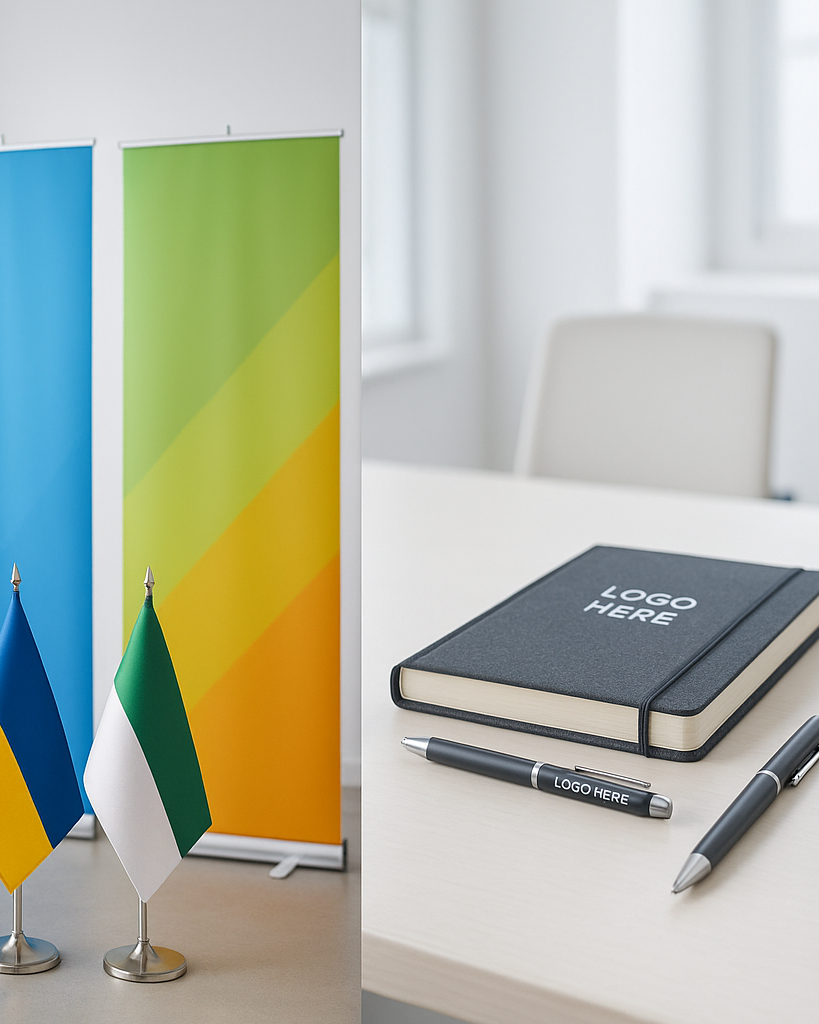
 Choosing banner stand width starts with one measurement: how far will viewers stand from the banner? As a practical rule, your headline text should be legible at the full expected viewing distance, and banner width must be wide enough that the design does not appear as a thin vertical sliver from that distance. For booths where visitors approach from 6–10 ft (1.8–3 m), a 33 in (84 cm) standard stand is almost always the right answer. For open exhibition halls or lobbies where the banner must catch attention from 20–30 ft (6–9 m), a 47 in (120 cm) or wider unit gives your message the visual weight it needs. The Portable Retractable Banner Stand rolls back neatly into its own base and sets up in seconds without tools — an important practical advantage when you are moving between events or setting up a multi-stop retail tour. Consider also the width of your table or floor space: a 33 in stand needs roughly 36 in (91 cm) of clear floor to sit without blocking foot traffic, while a 47 in stand needs closer to 52 in (132 cm) of clearance on each side of the base.
Pole height plays directly into width selection. A tall-narrow banner (say, 24 in wide × 80 in tall) has a 1:3.3 aspect ratio and reads like a tower — excellent for directing foot traffic along a corridor but hard to read laterally. A wide-short banner (47 in wide × 72 in tall) reads more like a billboard and suits open spaces where viewers scan left to right. Neither is wrong; they serve different spatial situations. When space is limited but you still need a wide visual footprint, consider pairing two standard 33 in stands side by side rather than fighting to fit one extra-wide base into a narrow booth alcove.
The Right Ratio Between Pole Height and Banner Width
A well-proportioned banner stand has a width-to-height ratio between 1:2 and 1:3 — meaning a 33 in (84 cm) wide banner should be between 66 in (168 cm) and 99 in (251 cm) tall. Ratios outside this range create designs that feel either squat and unstable or dangerously top-heavy on a lightweight base.
The practical implication: if the space you are working with forces an unusually short display height — such as a 60 in (152 cm) ceiling clearance in a basement venue — then you should also reduce your width. Forcing a 47 in wide graphic into a 60 in tall stand produces a nearly square banner that looks like a table card blown up to human scale. Drop to 33 in (84 cm) wide and the proportions correct themselves naturally. Conversely, if your venue has 10 ft (3 m) ceilings and you want maximum visual impact, extending to 80–92 in (203–234 cm) in height while using a 39–47 in (99–120 cm) wide stand keeps the ratio in the visually comfortable 1:2–1:2.4 range.
Weight stability is the other reason ratio matters. Bases for standard 33 in stands typically have a footprint of about 15–18 in (38–46 cm) and are engineered for a pole in the 72–80 in (183–203 cm) range. Extending significantly beyond the rated height shifts the center of gravity upward, and in high-traffic areas or near HVAC vents, an overextended banner can tip. Always verify the rated height range of the specific base you are ordering, and choose a width that the base was designed to support.
Indoor, Outdoor, and Desk Sizes Compared
 Indoor and outdoor banner stand sizing follows different logic, and the two should rarely be treated interchangeably. For indoor settings — trade show floors, conference rooms, hotel ballrooms, and school lobbies — the 33 in (84 cm) standard width is the market consensus for good reason: it fits through standard doorways (most interior doors clear 32–36 in / 81–91 cm), and the standard retractable base is engineered for smooth, level floors. Outdoor banner stands are a different category altogether; they need weighted or staked bases to resist wind, and graphics are typically printed on perforated or mesh materials to allow air to pass through. For printed fabric displays intended for institutional indoor use, the Customizable Raschel Fabric Banner is produced on durable Raschel knitted polyester — a material well suited to permanent wall-mount or framed display applications in schools, cultural centers, and public offices where longevity matters more than portability. Desk-top or tabletop banner stands occupy a third category: typically 10–14 in (25–36 cm) wide and 18–24 in (46–61 cm) tall, they are proportioned for conference table presentations, reception counters, and retail point-of-sale displays rather than open-floor visibility.
The table below summarizes the typical sizing breakdown across the three environments:
- Tabletop: 10–14 in (25–36 cm) wide × 18–24 in (46–61 cm) tall — countertop and desk displays.
- Indoor standard: 33 in (84 cm) wide × 72–80 in (183–203 cm) tall — trade shows, lobbies, presentations.
- Indoor wide: 47 in (120 cm) wide × 72–79 in (183–200 cm) tall — stage flanks, retail endcaps, 10 ft booths.
- Outdoor: 33–39 in (84–99 cm) wide × 60–72 in (152–183 cm) tall — weighted bases, wind-resistant graphics.
If you are deciding between a retractable roll-up stand and an X-frame for a specific event type, that comparison is covered in detail in the article Retractable Banner Stand vs X-Frame for Trade Shows, which walks through lifespan, total cost, and event-type fit side by side.

Banners & Accessories
Browse retractable stands, fabric banners, and display accessories sized for trade shows, retail, and institutional settings.
Browse Collection →Five Sizing Mistakes That Make Banner Stands Look Wrong
The most common banner stand sizing error is ordering a 33 in (84 cm) standard stand for a 10 ft (3 m) wide booth and then wondering why the display looks sparse. A 10 ft booth needs at least 94 in (240 cm) of total banner width — either two 47 in stands or three 33 in stands — to fill the backwall with authority. Here are the five mistakes seen most often in practice:
- Underscaling for the booth: A single standard stand in a 10 ft booth leaves 7 ft of blank space on each side. Plan for total graphic width to cover at least 70–80% of your booth's backwall.
- Overscaling for the room: A 47 in (120 cm) stand in a 36 in (91 cm) wide corridor simply will not fit through the door. Always measure doorway width before ordering wide or extra-wide stands.
- Ignoring ceiling height: Extending a 72 in (183 cm) base stand to 92 in (234 cm) in a room with an 8 ft (244 cm) ceiling leaves only 6 in (15 cm) of clearance — and many event venues ban displays above 7 ft (213 cm) for fire-safety sightline reasons. Confirm venue rules before you order extended-height units.
- Wrong base for the floor: Retractable bases are designed for flat, hard floors. Placing a standard indoor base on carpet, grass, or uneven concrete causes rocking and tips. Outdoor environments require a purpose-built weighted or staked base.
- Skipping a size test with printed content: The most avoidable mistake is finalizing hardware before the graphic is designed. A 33 in (84 cm) wide banner printed at 72 DPI looks fine on screen but blurry in person at 6 ft (1.8 m). Design the graphic first, verify legibility at scale, then confirm the banner size before ordering the stand.
For guidance on where printed banners perform best in outdoor settings — including surface choices and anchor types — the article Where Printed Banners Work Best Outdoors covers venue-specific recommendations in depth.
Getting the Right Size for Permanent and Institutional Displays
Not every banner stand is a temporary trade show tool — many organizations use them as semi-permanent displays in lobbies, reception areas, classrooms, and cultural centers, where sizing logic shifts from portability toward proportion and presence. For permanent or long-term indoor installations, the priority changes: instead of optimizing for travel weight, you optimize for the wall or floor zone the banner will occupy every day.
In a standard 8 ft (244 cm) ceiling room, a 33 in (84 cm) × 79 in (200 cm) banner stand fills a human-scale visual field without overwhelming the space. In double-height lobbies or atrium entrances, two 47 in (120 cm) wide stands positioned symmetrically flanking a reception desk create a balanced, institutional-grade presentation. The Banners & Posters collection includes fabric options suited to these longer-term display scenarios, where the banner's durability over months of continuous display matters as much as the stand itself. Schools, embassies, cultural organizations, and government offices often run banner displays continuously for 6 months to 2 years, so specifying a fabric that holds color and resists sagging under its own weight is as important as selecting the correct stand width.
What is the most common banner stand size for trade shows? +
How wide should a banner stand be for a 10 ft trade show booth? +
What is the difference between a retractable banner and a regular banner stand? +
Can I use an indoor banner stand outside? +
How tall should a banner stand be for maximum visibility? +
How do I pair banner stands with matching accessories for a complete display? +
What resolution should banner graphics be for different widths? +
Choosing the right banner stand size is fundamentally about matching three variables — your available floor space, your viewing distance, and your content's visual hierarchy — before you finalize hardware. For most trade show and retail applications, start with the Portable Retractable Banner Stand at 33 in (84 cm) wide, then step up to 47 in (120 cm) if your booth is 10 ft (3 m) or wider. For fabric-based institutional displays intended for schools, offices, or cultural centers, the Customizable Raschel Fabric Banner provides a durable Raschel knitted polyester surface suited to continuous display over months or years. The full Banners & Accessories collection brings stands, fabric banners, and display accessories together in one place. Bulk pricing is available for corporate orders requiring multiple units across events or locations — contact us with your booth dimensions and event schedule for a tailored recommendation.


