









Municipal buildings, city halls, and public libraries need indoor flag sets that meet federal protocol, project civic dignity, and hold up to daily use — and sourcing them in bulk shouldn't require months of back-and-forth with a supplier. Whether you're outfitting one council chamber or dozens of branch libraries across a county, this guide covers every decision point: correct sizing, US Flag Code compliance, display configurations, hardware selection, and how to structure a municipal building flags bulk order that saves your department time and budget.
Understanding Government Indoor Flag Protocol: What the US Flag Code Requires
The US Flag Code (4 USC §§ 1-10) establishes binding display rules for federal facilities and serves as the authoritative reference standard for state and local government buildings as well. When the US flag is displayed indoors alongside other flags — a state flag, a city flag, or an agency seal flag — the national flag must always occupy the position of honor: to its own right, which is the observer's left, typically on a floor stand placed at the right side of a podium or dais. No other flag in the indoor set may be positioned higher, larger, or more prominently than the US flag; if all flags are the same size, this rule is satisfied through placement alone. Many state governments layer additional requirements on top of federal code — for instance, several states mandate that the state flag appear directly to the left of the US flag in any multi-flag indoor arrangement, so procurement officers should verify their state's administrative code before finalizing display plans. Understanding these rules before you specify hardware and flag sizes prevents costly corrections after installation and ensures your building passes any compliance audit or ceremonial inspection.
Standard Sizing for Indoor Flag Sets in Municipal Settings
The most widely adopted indoor flag size for government offices, council chambers, and library meeting rooms is 3 ft × 5 ft (91 cm × 152 cm), mounted on a pole between 7 ft and 9 ft (213 cm–274 cm) tall. This sizing is the right balance between visual authority and practical fit — it fills a standard 9 ft to 10 ft (274 cm–305 cm) ceiling without crowding, and it works whether the display is a two-flag US-and-state set or a four-flag arrangement that adds a municipal flag and a POW/MIA flag. For larger ceremonial spaces such as council chambers, auditoriums, or grand library reading rooms with ceilings above 12 ft (366 cm), a 4 ft × 6 ft (122 cm × 183 cm) flag on a 9 ft pole creates the proportional presence the space demands. Desk or tabletop configurations — common on library reference desks, mayor's desks, or reception counters — typically use miniature flags at 4 in × 6 in (10 cm × 15 cm) on 10 in (25 cm) sticks, or larger desktop flags at 8 in × 12 in (20 cm × 30 cm). Always pair the flag size to the pole and base rated for that size; an undersized base on a 4 × 6 flag will tip, which is both a safety issue and a code-compliance concern under 4 USC § 8(b), which prohibits allowing the flag to touch the ground.
Choosing the Right Indoor Flag Stand for Government Offices
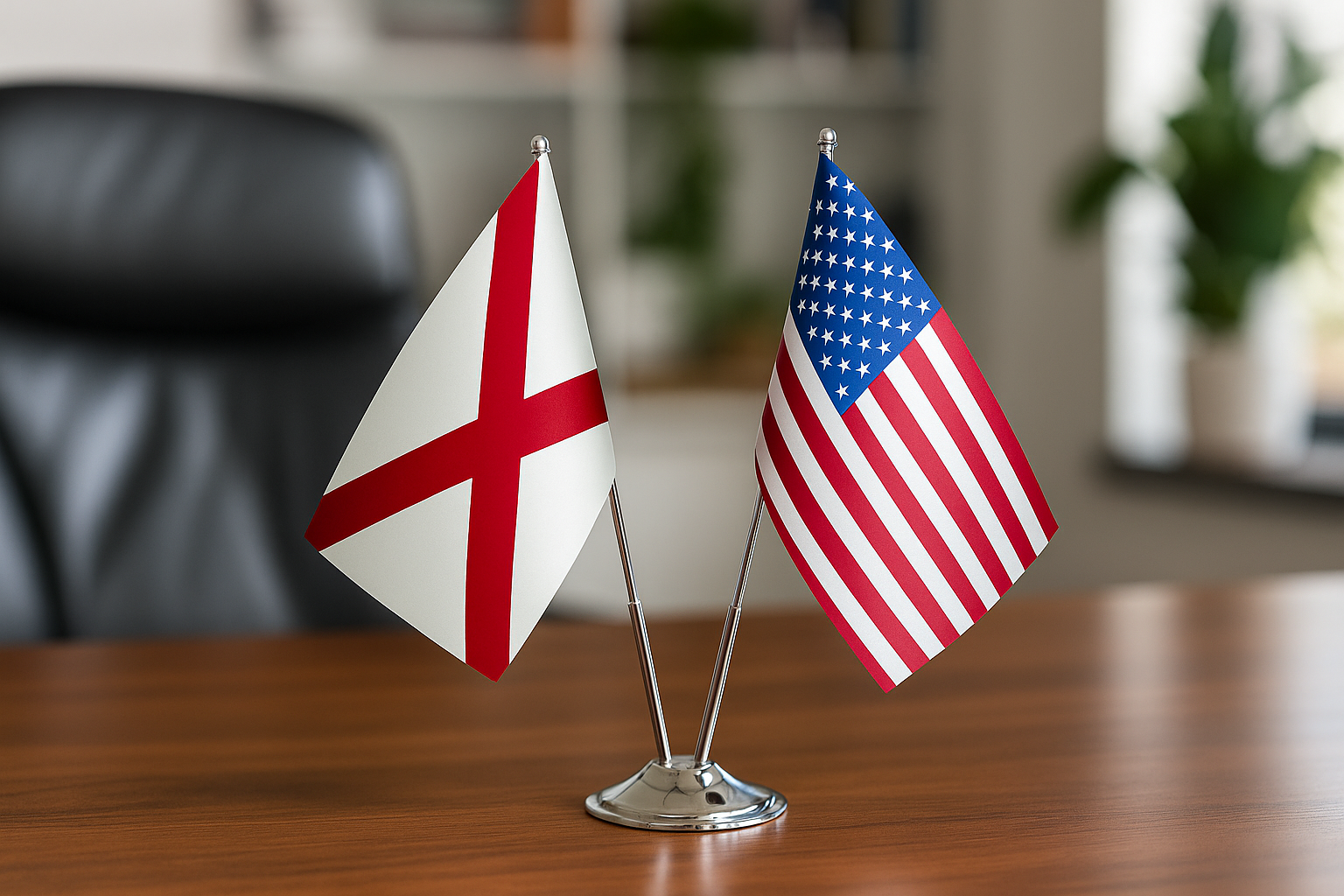
 Selecting the correct indoor flag stand for a government office is not a cosmetic decision — it directly affects flag code compliance, long-term durability, and the professional impression your building makes on constituents and visiting officials. For floor-standing displays, look for bases rated at a minimum of 7 lbs (3.2 kg) for 3×5 flags and 10 lbs (4.5 kg) for 4×6 flags; anything lighter will tip in high-traffic corridors or when air conditioning creates interior airflow. Chrome or gold-finished metal stands are the standard choice for formal settings like council chambers, judge's chambers, and executive offices because they maintain the gravitas appropriate to civic spaces — and a luxury chrome gold desk flag stand with a premium weighted metal base satisfies both the aesthetic and the stability requirements in one specification. For desk or conference table arrangements, choose stands available in single, double, triple, quad, or five-flag configurations so you can expand without sourcing additional hardware as your display requirements change. Procurement officers sourcing stands in bulk for multiple branch locations should request unit pricing breaks at quantities of 10, 25, and 50 units, as most suppliers offer 15%–30% discounts at those thresholds.
Floor stand poles for indoor use come in two primary materials: solid wood (typically walnut or oak finished with brass ferrules) and lightweight aluminum with anodized or plated finishes. Wood poles are the traditional choice for ceremonial rooms and chambers, projecting warmth and permanence; aluminum poles are preferred for high-turnover environments like library community rooms or training centers because they are corrosion-resistant, easy to wipe clean, and can absorb repeated assembly and disassembly without degrading. Both options should include an ornamental top — the gold ball finial is the most protocol-appropriate choice for federal and state flag sets, while the eagle finial is permitted but adds cost and weight. Confirm that the pole section joints use a positive-lock mechanism rather than friction-only fits, because friction-only joints loosen after repeated display changes and can cause poles to lean or separate mid-ceremony.
US Flag and State Flag Indoor Sets: Configuration Options for Public Buildings
 A complete US flag and state flag indoor set is the baseline configuration required in virtually every public-facing municipal space, and getting the pairing right — same size, same finish hardware, same fabric weight — is as important as getting placement right. Mismatched fabrics are the most common compliance and appearance error procurement teams encounter: pairing a heavyweight nylon state flag with a lightweight polyester US flag creates an uneven drape on stands that looks sloppy and wears unevenly. For standard indoor municipal use, 200-denier nylon with a satin finish is the most widely specified fabric because it produces a rich, luminous appearance under interior lighting, resists fading for 12 to 18 months under typical fluorescent and LED exposure, and is machine-washable — an important consideration for libraries and community centers where flags come into frequent contact with the public. The state and city indoor flags collection provides matched sets designed to pair directly with US flags for protocol-correct two- and three-flag configurations. For configurations that add a United Nations flag, a foreign national flag, or a branch-of-service flag, always consult the FIAV (Fédération Internationale des Associations Vexillologiques) standards alongside 4 USC to confirm precedence order, which can become complex in multi-flag ceremonial arrangements involving both domestic and international dignitaries.
Three-flag indoor sets — US flag, state flag, and municipal flag — are the most common configuration in city halls and county courthouses. Four-flag sets that add the POW/MIA flag are increasingly standard in public buildings following the National POW/MIA Flag Act (Public Law 116-67, 2020), which requires the POW/MIA flag to be flown at many federal facilities on six designated days per year and has prompted many municipalities to adopt year-round indoor display as a gesture of respect. Five-flag sets are typical in multi-jurisdictional offices such as regional transit authorities, joint library districts, or port authority buildings where both the city and county flags must appear alongside the US and state flags. When ordering bulk indoor flags for public libraries with multi-use community rooms, consider specifying a two- or three-flag set for permanent display and a separate set of pole-and-base hardware for temporary reconfiguration during special events — this protects your ceremonial set and gives programming staff flexibility without compromising the primary display.
Fabric and Finish Specifications That Matter for High-Traffic Municipal Environments
Indoor flags for city halls and libraries should be specified to a minimum 80% UV resistance rating and a flame-retardant finish that meets NFPA 701 standards, which is required for any fabric displayed in a public assembly space. These two specifications are non-negotiable for procurement officers and are the most frequently missed in generic flag purchasing. Nylon flags with embroidered stars and sewn stripes outlast digitally printed alternatives by approximately 40% under identical indoor conditions — the embroidered construction resists peeling, bleeding, and edge fraying that printed flags develop after repeated cleaning or humid environments like entryways. Headers should be reinforced with a minimum two-ply canvas sleeve rated for pole diameters between 1 in and 1.25 in (2.5 cm–3.2 cm), and brass grommets should be double-set rather than single-set to prevent tearing at the attachment points. Fringe trim — the gold or yellow fringe often seen on ceremonial indoor flags — is a traditional decorative element, not a protocol requirement under federal code, but it is widely used in council chambers and formal reception rooms and adds approximately 20%–30% to the per-flag cost; budget for it in formal spaces and omit it in working offices and library stacks areas where flags are handled frequently.
How to Structure a Municipal Building Flags Bulk Order
Structuring a government indoor flag bulk order correctly from the start eliminates the most common delays — mismatched specifications, incomplete hardware lists, and procurement approval bottlenecks. The first step is a complete site inventory: count every room, lobby, and meeting space that requires a flag display, categorize them by configuration (2-flag, 3-flag, desk display), note ceiling heights, and record whether existing hardware can be reused or must be replaced. A single municipal library system with 12 branches might require 36 floor-standing flags (three per branch), 24 floor stands, 12 desk flag sets for reference counters, and a 10% overage for replacements — documenting this in a single specification sheet allows suppliers to quote accurately and allows your purchasing department to issue one purchase order rather than a series of small orders that inflate administrative costs. Minimum order quantities for wholesale indoor flags for municipalities typically start at 10–25 units per SKU to access wholesale pricing; at quantities of 50 or more flags per SKU, most manufacturers can offer custom embroidered or printed additions such as a city seal, agency logo, or event year at no additional setup cost.
Indoor Flags Collection
Protocol-correct indoor flag sets for government offices, city halls, courthouses, and public libraries — available in bulk with matched hardware options.
Browse Collection →Request a written specification confirmation from your supplier before issuing a purchase order — this document should list fabric type, weight in denier, flag dimensions with tolerances of no more than ±0.5 in (1.3 cm), finish type (embroidered vs. printed), fringe inclusion, header type, grommet count and material, pole diameter compatibility, and base weight. For orders covering multiple locations under a single government entity, ask whether the supplier can package flags by location (i.e., pre-sorted into labeled sets per branch) and whether they offer a government procurement account with net-30 or net-60 terms, which most municipal purchasing departments require. Lead times for custom or bulk indoor flag orders typically run 10–21 business days for standard specifications and 25–35 business days for custom embroidery or non-standard sizing, so build those windows into your procurement calendar, especially ahead of grand openings, legislative sessions, or ceremonial dedications.
Replacement Cycles, Maintenance, and Long-Term Budget Planning
Indoor flags in municipal buildings typically last 12 to 24 months before requiring replacement, depending on traffic exposure, cleaning frequency, and UV exposure from windows or strong interior lighting. Establishing a formal replacement cycle — rather than replacing flags only when they visibly deteriorate — protects your building's civic image and keeps compliance reviewers satisfied. A practical approach for large municipal systems is to schedule replacement on an 18-month rolling cycle, staggered so that roughly one-third of your locations are refreshed every six months; this smooths the budget impact across fiscal years and prevents the situation where a large number of flags need replacement simultaneously at the start of a new fiscal year when procurement accounts may be constrained. Maintenance between replacement cycles should include monthly inspection for fraying, color fading, and grommet integrity; quarterly gentle hand-washing with mild detergent for nylon flags; and immediate replacement of any flag that is torn, faded beyond recognition, or damaged per 4 USC § 8(k), which requires that worn or soiled flags be destroyed in a dignified manner — coordinate with your local American Legion or VFW post for flag retirement ceremonies, which also serves as a positive community engagement opportunity for your library or city hall.
Frequently Asked Questions
What is the correct placement order for indoor flag sets in a city hall or government office? +
What size indoor flag is standard for a city council chamber or library meeting room? +
What is the minimum order quantity for a wholesale indoor flag purchase for a municipal system? +
Is the gold fringe on ceremonial indoor flags required by the US Flag Code? +
What fabric is best for indoor flags in high-traffic public buildings like libraries? +
Does the POW/MIA flag need to be included in indoor municipal flag sets? +
How often should indoor flags in government buildings be replaced? +
Can we order indoor flag sets pre-sorted by location for a multi-branch library system? +
Equipping every city hall, library branch, and municipal office with protocol-correct indoor flag sets is a visible commitment to civic dignity and legal compliance — and it doesn't have to be complicated when you work with a manufacturer that understands government procurement requirements. Browse the full indoor flags collection for US flag and state flag sets in every standard indoor size, explore state and city indoor flags to complete your multi-flag configurations, and review our premium weighted metal flag stands for hardware that matches the formality of your space. Bulk pricing is available for corporate and government orders — contact our institutional sales team with your site inventory and flag specifications for a custom quote with volume discounts and flexible payment terms suited to municipal procurement timelines.


