









When outfitting a government office, courthouse, or capitol building with the correct indoor state flag sets, the details matter — from flag dimensions and fabric weight to pole height, stand type, and display order. Indoor state flag sets for government offices must comply with established federal and state protocol, project institutional authority, and withstand daily indoor use for years. This guide covers every aspect of proper flag display in official settings, including courthouse flag display protocol, sizing standards, stand selection, and how to place a bulk state flag order that meets procurement requirements.
Federal and State Protocol for Indoor Flag Display in Government Buildings
The US Flag Code (4 USC §§ 1-10) establishes the hierarchy for indoor flag display: the US flag always occupies the position of honor, which indoors is to the speaker's right (the audience's left) when flags are displayed on staffs. Every government office displaying a state and US flag indoor set must adhere to this rule without exception, regardless of the state agency or jurisdiction involved. When a state flag is paired with the national flag, the US flag is placed to its own right, with the state flag to its left from the observer's perspective.
For courthouses, additional considerations apply. Federal district courthouses typically follow guidance from the Administrative Office of the US Courts, which recommends that courtroom flag arrangements mirror the precedence established in 4 USC § 7(k): the US flag on the judge's right, state flag on the judge's left, and any additional flags — such as a judicial seal or POW/MIA flag — displayed in order of precedence outward. State capitol buildings and governor's offices follow their own state statutes, many of which codify identical precedence rules. For example, California Government Code § 430 and Texas Government Code § 3100.002 both specify that the US flag shall take precedence over the state flag in joint displays. Always verify your state's specific statutory requirements before finalizing any government office flag protocol arrangement.
When three or more flags are displayed in a line, flags should be arranged so the US flag is at the center and highest, or at the far right of the line (from the flags' own perspective). In a semicircular arrangement common in legislative chambers and large courtrooms, the US flag anchors the center position. These rules apply uniformly whether you are installing flags in a small municipal courtroom or a state senate chamber.
Standard Sizing for Indoor State Flags in Official Settings
The correct indoor flag size for a government office depends on the ceiling height and the size of the room, and most official settings use flags measuring 3 ft × 5 ft (91 cm × 152 cm) or 4 ft × 6 ft (122 cm × 183 cm) on poles ranging from 7 ft to 9 ft (213 cm to 274 cm) tall. These dimensions are not arbitrary — they reflect FIAV (Fédération Internationale des Associations Vexillologiques) proportional standards and practical display guidelines developed for civic interiors.
- Small offices and chambers (under 400 sq ft / 37 m²): 3 ft × 5 ft (91 × 152 cm) flag on a 7 ft (213 cm) pole
- Standard government offices and conference rooms (400–900 sq ft / 37–84 m²): 4 ft × 6 ft (122 × 183 cm) flag on an 8 ft (244 cm) pole
- Courtrooms, hearing rooms, and large chambers (over 900 sq ft / 84 m²): 4 ft × 6 ft (122 × 183 cm) or 5 ft × 8 ft (152 × 244 cm) flag on a 9 ft (274 cm) pole
- Rotundas and legislative halls: 5 ft × 8 ft (152 × 244 cm) or larger, suspended or floor-mounted on 9–10 ft (274–305 cm) staffs
Pole diameter also matters for institutional settings. A 1-inch (2.54 cm) diameter pole is standard for 3×5 flags, while 4×6 and larger flags require a 1⅛-inch (2.86 cm) or 1¼-inch (3.18 cm) diameter pole to prevent bowing. Brass or chrome-finished aluminum poles are the preferred choice for government interiors — they maintain a formal appearance, resist corrosion, and meet the weight demands of heavier wool or nylon flag fabrics used in official official state flag for capitol building installations.
Fabric and Construction Requirements for Government-Grade Indoor Flags
Government-grade indoor state flags should be constructed from two-ply polyester or heavyweight nylon with embroidered or appliquéd seals — not printed — because embroidered detail holds color and definition under sustained indoor lighting for 2 to 5 years without fading. Printed flags, while less expensive, can fade noticeably within 6 to 18 months under fluorescent or LED lighting, which is unacceptable in a courthouse or capitol setting where flags represent institutional permanence.
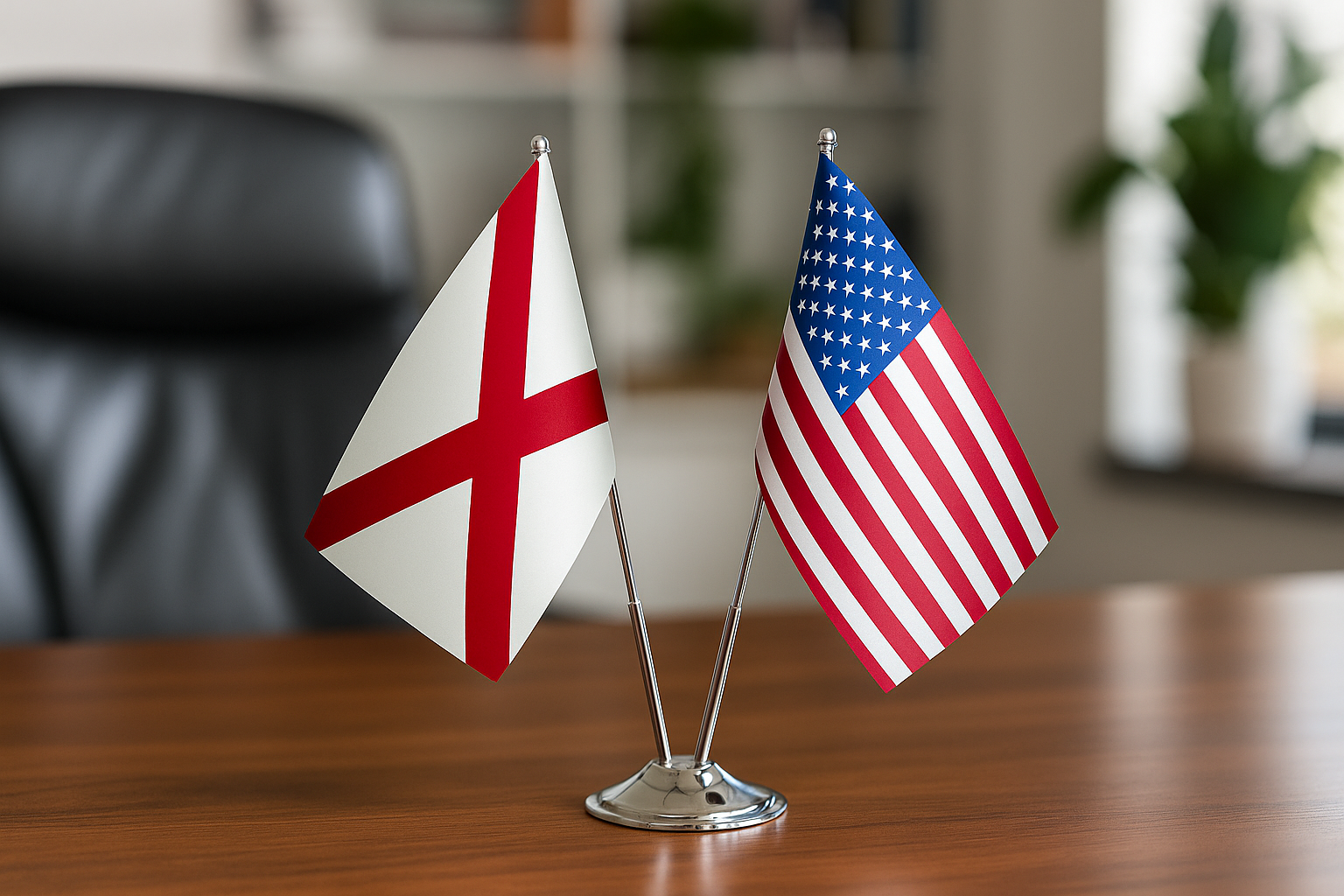
 For agencies seeking a ready-made solution, paired state and US flag indoor sets offer a cost-efficient and protocol-correct way to equip multiple offices simultaneously. These sets typically include both flags in matched dimensions, ensuring consistent appearance across an entire building or agency campus. The Alabama and US Flag Set is a strong example of the quality standard to look for — matched sizing, reinforced heading with brass grommets, and colorfast fabric designed for sustained indoor display. When ordering for a courthouse or government complex, specifying matched sets eliminates procurement mismatches and simplifies installation across dozens of offices.
Key fabric specifications to request in government procurement documents include: minimum 200-denier nylon or 2-ply polyester, double-stitched fly hem, canvas heading (not plain fabric), brass grommets or sleeve attachment, and colorfast dye rated for a minimum of 80% UV resistance even for indoor applications. The sleeve or pole-pocket attachment is increasingly preferred in formal settings because it presents a cleaner silhouette than grommet-and-hook hardware. Always request a material data sheet or certificate of compliance from your supplier when ordering for official use.
Choosing the Right Stand for Indoor State Flag Sets
The stand is just as important as the flag itself in a formal government setting, and the wrong base — flimsy, undersized, or visually mismatched — immediately undermines the professional appearance of an otherwise correct flag display. For courthouses, executive offices, and capitol buildings, weighted metal bases in chrome or gold finish are the institutional standard, providing the stability needed for 4×6 flags on 8–9 ft poles without tipping risk.
 The Luxury Chrome Gold Desk Flag Stand with Premium Weighted Metal Base is available in single, double, triple, quad, and five-flag configurations, making it an ideal solution for both individual offices and multi-flag conference room or hearing room arrangements. The weighted metal base provides the low center of gravity necessary to stabilize taller poles in high-traffic spaces where doors opening and closing create air movement. Its chrome and gold finish coordinates with standard government interior hardware — door handles, light fixtures, and podium fittings — creating a cohesive, authoritative appearance. For agencies equipping an entire courthouse floor or a suite of executive offices, ordering these stands in matching configurations ensures visual consistency that reflects well on the institution. Explore the full range of mounting and stand solutions in the Bases and Stands collection to find configurations that fit your specific display requirements.
For floor-standing government flag displays, look for bases with a minimum weight of 5 lbs (2.27 kg) for 7 ft poles and 8 lbs (3.63 kg) or more for 8–9 ft poles. Antique brass, polished chrome, and satin gold finishes are all appropriate for formal settings. Avoid plastic or lightweight cast-metal bases, which can crack under the lateral stress of a heavy flag pole and present an unprofessional appearance in high-visibility spaces like courtrooms or the governor's reception area.
State and City Indoor Flags Collection
Browse protocol-correct indoor state and city flags built to government-grade fabric and construction standards for official display in courthouses, offices, and capitol buildings.
Browse Collection →Courthouse Flag Display Protocol: Room-by-Room Guide
Courthouse flag display protocol varies by room type, and each space within a courthouse has distinct display requirements that reflect both legal protocol and the seriousness of the proceedings conducted there. The courtroom itself demands the strictest adherence: the US flag and state flag must be on staffs flanking the judge's bench, with the US flag to the judge's right and the state flag to the judge's left.
Here is a room-by-room breakdown of standard courthouse flag display:
- Courtrooms: US flag (judge's right) + state flag (judge's left) on 8–9 ft staffs with weighted bases. POW/MIA flag may be added at the judge's discretion per Public Law 105-85.
- Clerk's office and public counters: Smaller 3×5 ft (91×152 cm) flags or framed state and US flag sets on desk stands are appropriate.
- Jury assembly rooms: US flag required; state flag recommended. 4×6 ft (122×183 cm) on 8 ft (244 cm) poles.
- Judge's chambers: Desk-format dual flag stands with 4-inch (10 cm) miniature flags or full 3×5 ft (91×152 cm) floor flags, depending on room size.
- Main lobby and entrance hall: Ceremonial display with full-size 4×6 ft (122×183 cm) or 5×8 ft (152×244 cm) flags, often with gold fringe on state flag for decorative effect.
- Conference and mediation rooms: Paired 3×5 ft (91×152 cm) flags on 7 ft (213 cm) poles with matching stands.
Gold fringe on indoor flags is a decorative element permitted by protocol — it does not alter the flag's official status. The US Army Institute of Heraldry confirms that gold fringe on the US flag is acceptable for indoor ceremonial use and has been standard on military and courtroom flags since the 19th century. State flags with matching gold fringe are available from most government flag suppliers and are appropriate for all courthouse and capitol building applications.
How to Place a Bulk State Flag Order for Government Procurement
Placing a bulk state flag order for a government agency requires attention to procurement documentation, lead time, fabric specifications, and quantity discounts that can significantly reduce per-unit cost. Most government agencies ordering 10 or more flag sets can expect 15–30% reductions from standard retail pricing when ordering directly from a manufacturer.
The procurement process for a government flag order typically involves these steps:
- Needs assessment: Count the number of offices, courtrooms, and common areas to be equipped. Document ceiling heights, room sizes, and existing pole/stand inventory.
- Specification development: Write specifications covering flag dimensions, fabric type, construction method (embroidered vs. printed), pole diameter, finish, and base weight. Reference FIAV standards and 4 USC §§ 1-10 in the spec document.
- Quote request: Submit a Request for Quote (RFQ) to qualified flag manufacturers. Include quantity, delivery timeline, and any required certifications (Buy American Act compliance, ISO certification, etc.).
- Sample review: Request physical samples before approving a bulk order. Verify color accuracy against official state flag standards published by your state's secretary of state office.
- Purchase order: Issue a PO referencing the approved sample and specifications. Build in a 20–25% buffer for replacements over the contract period.
- Delivery and inspection: Inspect a random sample of at least 10% of delivered flags for stitching quality, color accuracy, and dimensional correctness before accepting the full order.
Lead times for bulk government orders typically run 2–4 weeks for stock items and 4–8 weeks for custom or embroidered flags. Plan procurement cycles accordingly, especially if you are equipping a new building or replacing flags for an official opening or inauguration event. The Indoor Flags collection offers a comprehensive range of state flags in standard government sizes, making it straightforward to identify the right products before drafting your procurement specifications.
Maintaining Indoor State Flags in Government Settings
A well-maintained indoor state flag set signals institutional respect and extends the useful life of your investment — expect a quality indoor nylon or polyester flag to last 2 to 5 years in a government office with proper care, compared to 6 to 12 months for outdoor flags in comparable use. Regular maintenance is simple but essential in high-visibility official environments.
Establish a quarterly flag inspection protocol for all government offices and courtrooms. Inspect for fraying along the fly hem (the free edge), fading or discoloration, torn heading or damaged grommets, and pole or stand damage. Flags that show visible fraying or fading should be retired and replaced — displaying a deteriorated flag in a courthouse or government office is a protocol violation and projects institutional neglect. Under 4 USC § 8(k), worn or soiled flags should be destroyed in a dignified manner, typically by burning in a private ceremony. Many American Legion and VFW posts offer flag retirement services at no cost to government agencies.
Cleaning indoor flags extends their life significantly. Most nylon and polyester government flags can be machine-washed on a gentle cycle in cool water with mild detergent, then air-dried flat. Do not machine-dry flags with embroidered details — heat causes thread shrinkage that distorts embroidered seals and insignia. Establish a cleaning schedule of every 3–6 months for flags in high-traffic spaces like lobby areas and courtrooms.
Frequently Asked Questions
What is the correct order of precedence for indoor state flag sets in government offices? +
What size indoor state flag is appropriate for a courthouse courtroom? +
Does the US Flag Code require government offices to display a state flag alongside the US flag? +
What is the minimum quantity for a bulk state flag order, and what discounts are available? +
What type of stand should be used for indoor state flags in a formal government setting? +
How long do indoor government-grade state flags typically last? +
Is gold fringe on indoor state flags protocol-correct for government use? +
Can I order state and US flag sets that are already matched in size and fabric for courthouse installations? +
Equipping government offices, courthouses, and capitol buildings with the correct indoor state flag sets is both a legal obligation and a mark of institutional professionalism. Whether you are outfitting a single judge's chambers or procuring flags for an entire courthouse complex, the right combination of protocol-correct sizing, quality fabric, and authoritative stands makes a significant difference in how the space presents to the public. Explore the complete State and City Indoor Flags collection for government-grade options in every state, or browse the full range of US State Dual Desk Flag Sets for smaller offices and conference rooms. For matching display hardware, the Bases and Stands collection offers weighted metal bases in every configuration from single to five-flag arrangements. Bulk pricing is available for corporate and government procurement orders — contact Asya Bayrak LLC directly with your quantity, specifications, and delivery timeline to receive a formal government quote.


