





Minnesota's new state flag features a deep blue field with a single eight-pointed white star, known as the North Star, centered on the left half — a bold redesign that took effect on May 11, 2024, replacing the state's 130-year-old seal-based flag. If you want to fly it at home, school, or a government office, the US State Flags collection carries every format of the new design, from outdoor flagpole flags to handheld stick flags. This article covers what the colors and star mean, how the flag came to be, where the design elements originate, how it compares to flags it resembles, and what standards govern its display today.
What the Colors and the North Star Actually Mean on Minnesota's Flag
The new Minnesota flag uses three elements — a deep blue field, a white eight-pointed star, and a light blue wavy line — each carrying a specific, officially adopted meaning. The deep blue background represents Minnesota's sky and its more than 10,000 lakes. The white eight-pointed star is the North Star, which appears in the state motto L'Étoile du Nord ("The Star of the North"), a French phrase adopted in 1861 that reflects the state's position as the northernmost of the contiguous 48 states. The light blue wavy line running diagonally beneath the star represents the Mississippi River, which originates at Lake Itasca in northern Minnesota before flowing south through the continent. White on the star also carries a secondary reading of winter snow, connecting the design to the region's climate identity. Every element was deliberately chosen to be readable from a distance, making the flag legible at flagpole height without binoculars — a principle known in vexillology as the "basic flag design" standard promoted by the North American Vexillological Association (NAVA), which rated the old Minnesota flag among the worst-designed in the country.
How the Old Flag Was Replaced and the New Design Was Chosen
Minnesota's State Emblems Redesign Commission, established by the state legislature in 2023, oversaw a public submission process that received more than 2,600 design entries before narrowing the field to a final approved flag. The process began formally with the passage of Minnesota Laws 2023, Chapter 68, which created the commission and set a May 2024 deadline for adoption. The old flag — a blue field bearing the full state seal surrounded by a wreath of lady slippers and the state name — had been used since 1893 and was widely criticized for being impossible to reproduce from memory and visually indistinguishable from dozens of other state "seal-on-blue" flags. Designer Andrew Prekker's concept, refined through public feedback, became the official design. The commission voted to adopt the new flag on January 10, 2024, and Governor Tim Walz signed the legislation on February 7, 2024. The flag formally replaced the old design on May 11, 2024 — Statehood Day — marking the first major redesign in Minnesota's history. It is one of the most significant flag redesigns by any U.S. state in the modern era, alongside Mississippi's 2020 redesign.
For government offices, legislative chambers, and courthouses that need to display the new design with institutional precision, the Minnesota Official Indoor Flag reproduces the state seal and the new emblem via high-definition dye-sublimation printing on double-layer satin fabric, mounted on a durable chrome or gold metal pole. Satin fabric — available in 100, 150, and 165 g/m² weights — produces sharp color saturation and a formal drape that suits ceremony settings where a flag stands beside a podium or desk. The indoor format is the standard choice for state legislature halls, governor's offices, and public institutions where the flag is displayed stationary rather than flown in wind. If you are updating your office display to reflect the official 2024 redesign, this product ensures accuracy down to the star's exact geometry and the river line's proportions.
Where the Eight-Pointed Star Design Comes From
The eight-pointed star on Minnesota's flag is not an arbitrary decorative shape — it has roots in both heraldic tradition and the state's own history. Minnesota's state motto, L'Étoile du Nord, has referenced the North Star since territorial days, and the star appeared in various forms on the old seal and earlier flag iterations. The choice of eight points rather than the more common five-pointed star distinguishes the design and gives it a sunburst quality that increases its visibility on a flag field. In vexillological terms, an eight-pointed star (sometimes called an octagram or compass star) is associated with navigational symbolism — a natural fit for a state whose identity is tied to water, exploration, and geographic position at the northern edge of the lower 48. The star's white color against the deep navy blue creates maximum contrast, meeting NAVA's guideline that a flag should be legible at 100 ft (30 m) or more. The specific shade of blue is officially designated as Minnesota Blue, a custom Pantone-matched color that sits deeper than standard navy, reinforcing the lake and sky imagery without competing with the star's brightness. The wavy river line beneath the star is rendered in a lighter, sky blue, ensuring the star remains the dominant visual element while the secondary symbol still reads clearly.
Flags That Look Similar and How to Tell Them Apart
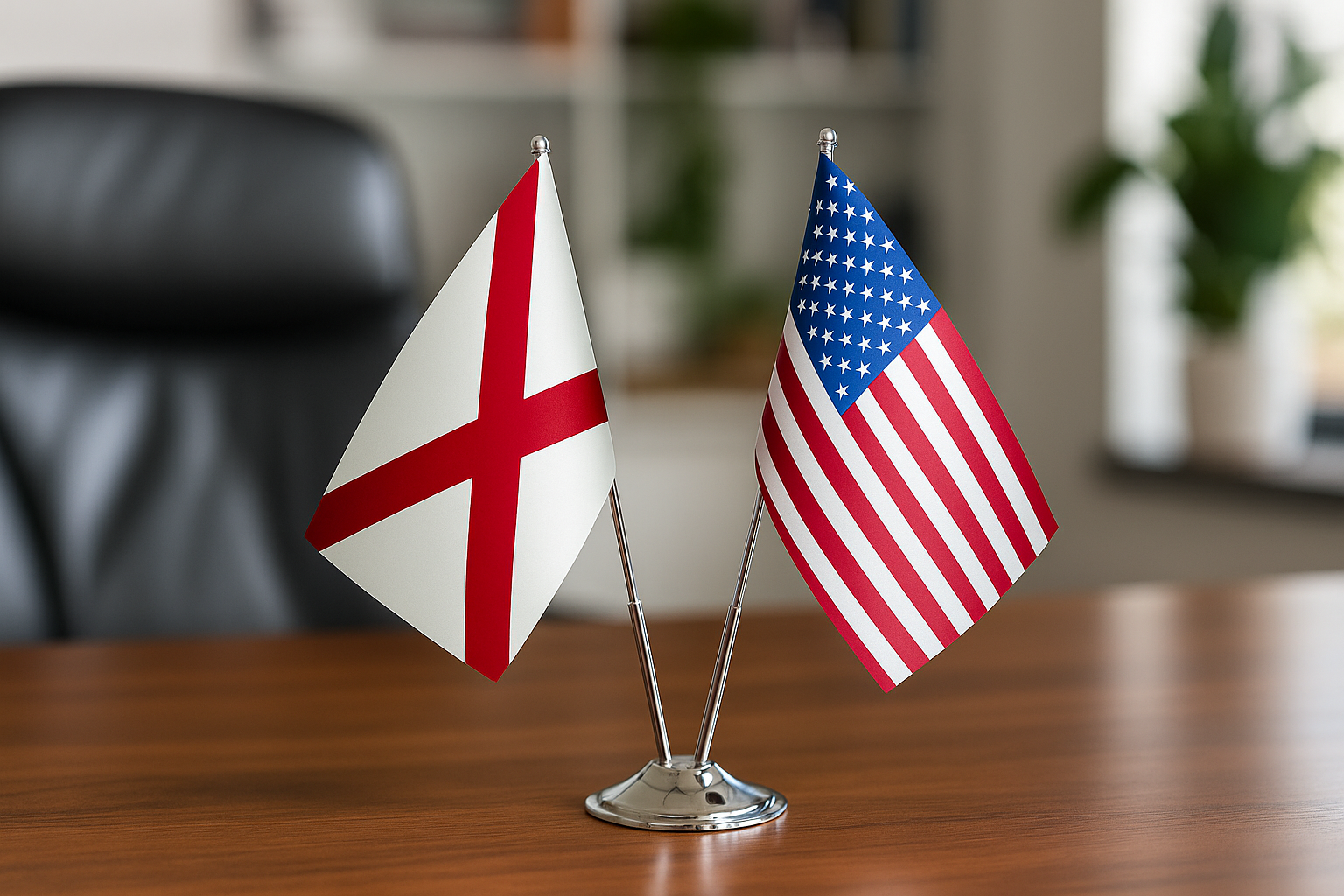
Minnesota's new flag is frequently compared to the flags of Alaska and several Nordic countries, but the differences are clear once you know what to look for. Alaska's flag also features a blue field with a single prominent star — Polaris, the North Star — but Alaska's design shows the entire Big Dipper constellation (Ursa Major) in gold against a navy background, with no wavy line element. Minnesota's flag has a single white star with a diagonal river line and no additional constellation. The Nordic countries — Sweden, Norway, Denmark, Finland, and Iceland — all use the offset Nordic cross on colored fields, which is structurally different from Minnesota's design; the superficial similarity is simply that several of them also use blue and white. Some observers compare the new flag to Puerto Rico's flag because both use a single star on a blue-dominant design, but Puerto Rico's flag has a triangular charge on a striped field, making it immediately distinguishable. Within the United States, the redesign places Minnesota in a small group of states with genuinely simple, distinctive flags — alongside New Mexico's sun symbol, Texas's lone star, and Ohio's burgee — which the vexillological community considers the gold standard for state flag design.
 For residential and commercial flagpole use, the Minnesota State Outdoor Flag is made from 110 g/m² Raschel knitted polyester, a fabric specifically recommended for outdoor display because it resists wind fatigue and handles UV exposure for 6 months to 2 years depending on climate and sun hours. It is available in eight sizes, from 1.6×2.5 ft (50×75 cm) up to 6.5×10 ft (200×300 cm), including the standard 3×5 ft (100×150 cm) size most commonly used on residential and business flagpoles across Minnesota. The flag is digitally printed and heat-fixed to maintain color accuracy on the deep Minnesota Blue field and the white star. If you are upgrading from an old seal-based flag to the official 2024 design, this is the product to fly on a standard outdoor pole — and it pairs correctly with the US flag when flown together under the protocols of 4 USC § 7, which governs the relative position of state flags alongside the national flag.
Official Size Standards and Display Rules for the New Minnesota Flag
Minnesota state law does not mandate a specific aspect ratio for the new flag's everyday use, but the official design specification adopts a 2:3 ratio, meaning a standard 3×5 ft (91×152 cm) flag is proportionally correct for general display. The star is positioned at the horizontal center of the left half of the field, and the wavy river line runs from the lower-left toward the upper-right at a specified diagonal angle. Under 4 USC § 7(e) of the US Flag Code, when a state flag is displayed on the same pole as the US flag, the national flag must always occupy the top position. When displayed indoors at a ceremony with multiple flags on separate staffs, the US flag takes the position of honor to the speaker's right, and the Minnesota flag stands to the speaker's left. For building facades and exterior walls, Minnesota flags may be displayed horizontally or vertically; the Minnesota State Vertical Flag is specifically designed for vertical display on building fronts and business entrances, available in four sizes from 1.6×6.5 ft (50×200 cm) to 3.3×13 ft (100×400 cm). State agencies in Minnesota were directed to transition to the new flag by May 11, 2024, though practical replacement timelines for all installations across the state extend further. Schools, courthouses, and municipal buildings displaying the old seal-based flag are encouraged to update their displays; the new design is now the only legally recognized state flag of Minnesota.

US State Flags
Every US state flag in outdoor, indoor, vertical, and handheld formats — including the officially updated 2024 Minnesota design.
Browse Collection →The Minnesota redesign joins a broader national conversation about state flag quality. For readers curious about similar recent or notable state flag designs, our article on Georgia State Flag Sizes and the Ring of 13 Stars covers another state flag with strong symbolic geometry, and our piece on Hawaii Flag Sizes and Its Eight Stripes examines another distinctive US state flag with a layered historical meaning worth understanding.
Frequently Asked Questions About Minnesota's New Flag
When did Minnesota adopt its new flag? +
What does the star on the new Minnesota flag represent? +
What do the wavy line and the blue colors mean on the new flag? +
Is the old Minnesota flag still legal to display? +
How is Minnesota's new flag different from Alaska's flag? +
What size Minnesota flag should I fly on a standard residential flagpole? +
Are there handheld Minnesota flags with the new design available for events? +
Whether you are flying the new Minnesota flag from a home flagpole, mounting it in a government office, or handing them out at a community event, every format of the official 2024 design is available through Asya Bayrak. The Minnesota State Outdoor Flag in 110 g/m² Raschel polyester covers standard flagpole use in eight sizes; the Minnesota Official Indoor Flag on a satin-fabric pole mount suits institutional and ceremonial settings; and the US State Vertical Flags collection carries the vertical format for building facades. For schools, municipalities, and government offices updating their displays to comply with the 2024 state flag law, bulk pricing is available for corporate and institutional orders — contact us directly for volume quotes.


