








Municipal and local government agencies can streamline their flag purchasing by working with a single wholesale supplier that offers outdoor pole flags, indoor ceremonial sets, and bulk pricing under one roof — reducing procurement time, ensuring consistent quality, and maintaining full compliance with the US Flag Code (4 USC §§ 1-10). Whether you manage procurement for a city hall, courthouse, public library, or community center, this guide covers everything you need to know about local government flag purchasing: materials, sizing, display standards, and how to place a municipal flags bulk order that delivers long-term value. Explore the full range of options at Asya Bayrak's USA Outdoor Flag page to see the quality and specifications available for government accounts.
Choosing the Right Outdoor Pole Flags for City Halls and Courthouses
 The right city hall outdoor flag must withstand continuous outdoor exposure while projecting the dignity appropriate for a government building. For most municipal flagpoles standing 20–30 ft (6–9 m), the standard flag size is 3 ft × 5 ft (0.9 m × 1.5 m) or 4 ft × 6 ft (1.2 m × 1.8 m); taller poles of 40–60 ft (12–18 m) typically require 5 ft × 8 ft (1.5 m × 2.4 m) or even 6 ft × 10 ft (1.8 m × 3 m) flags to maintain proper visual proportion. Commercial-grade 200-denier nylon is the most widely used material for outdoor pole flags at city hall because it offers approximately 80% UV resistance, dries quickly after rain, and typically delivers a service life of 6 months to 2 years depending on regional wind and sun exposure. Heavyweight 600-denier polyester is the preferred choice for coastal municipalities, high-wind corridors (those experiencing sustained winds above 25 mph / 40 km/h), and northern climates where icy conditions require a more durable weave. Procurement officers should also specify reinforced canvas headers with brass grommets — at minimum two grommets spaced 1 ft (30 cm) apart — to prevent premature wear at the attachment point, which is the most common failure mode in high-cycle flagpole environments. Browse the full range of logo-printed outdoor pole flags to see custom municipal emblem options alongside standard national and state designs.
Procurement managers for government building flag display programs should also account for replacement cycles when setting annual budgets. In a typical Midwestern or Southern US city with moderate wind, a quality nylon flag flown daily will need replacement every 6–9 months; in windy coastal or mountain locations, budgeting for quarterly replacement is more realistic. Ordering flags in multiples — a common practice in bulk flags for public buildings programs — reduces per-unit cost significantly, often by 15–30% compared to single-unit pricing, and ensures a ready stock of replacements so buildings are never left without a properly displayed flag.
US Flag Code Compliance for Government Buildings
Federal law and local government protocol are not optional — full compliance with the US Flag Code (4 USC §§ 1-10) is mandatory for all public buildings that receive federal or state funding. The Flag Code specifies that the US flag must occupy the position of honor: when displayed on a straight horizontal or angled staff projecting from a windowsill, balcony, or building, the union (blue field) must be at the peak unless the flag is at half-staff. When multiple flags are flown on adjacent poles of equal height — a common configuration at courthouses and city halls that display the US flag, the state flag, and a municipal flag simultaneously — the US flag must always be at the center and at the highest point, or at its own right (the observer's left).
State-level rules add another layer of requirements. Many states have their own flag display statutes that govern the order of precedence between the state flag and municipal flag, specify minimum flag sizes for government buildings of particular square footage, or mandate retirement protocols for worn flags. Procurement officers are encouraged to cross-reference state statutes before finalizing display configurations. For municipalities that wish to fly a custom city or county emblem flag alongside the national and state flags, FIAV (Fédération Internationale des Associations Vexillologiques) design standards provide useful guidance on proportion, color specification, and symbolism that help ensure a professionally designed flag holds up at full scale on a government pole.
Indoor Ceremonial Flag Sets for Council Chambers and Official Offices
An indoor ceremonial flag set for government use is a distinct product category from outdoor flags and requires different materials, hardware, and sizing conventions. Indoor ceremonial sets are displayed in council chambers, mayoral offices, courtrooms, and public meeting rooms, where they serve a formal, protocol-driven role — and where appearance and permanence matter more than weather resistance. Standard indoor ceremonial flag sizes are 3 ft × 5 ft (0.9 m × 1.5 m) on an 8 ft (2.4 m) pole for most office and chamber settings, and 4 ft × 6 ft (1.2 m × 1.8 m) on a 9 ft (2.7 m) pole for large courtrooms or auditoriums with high ceilings.
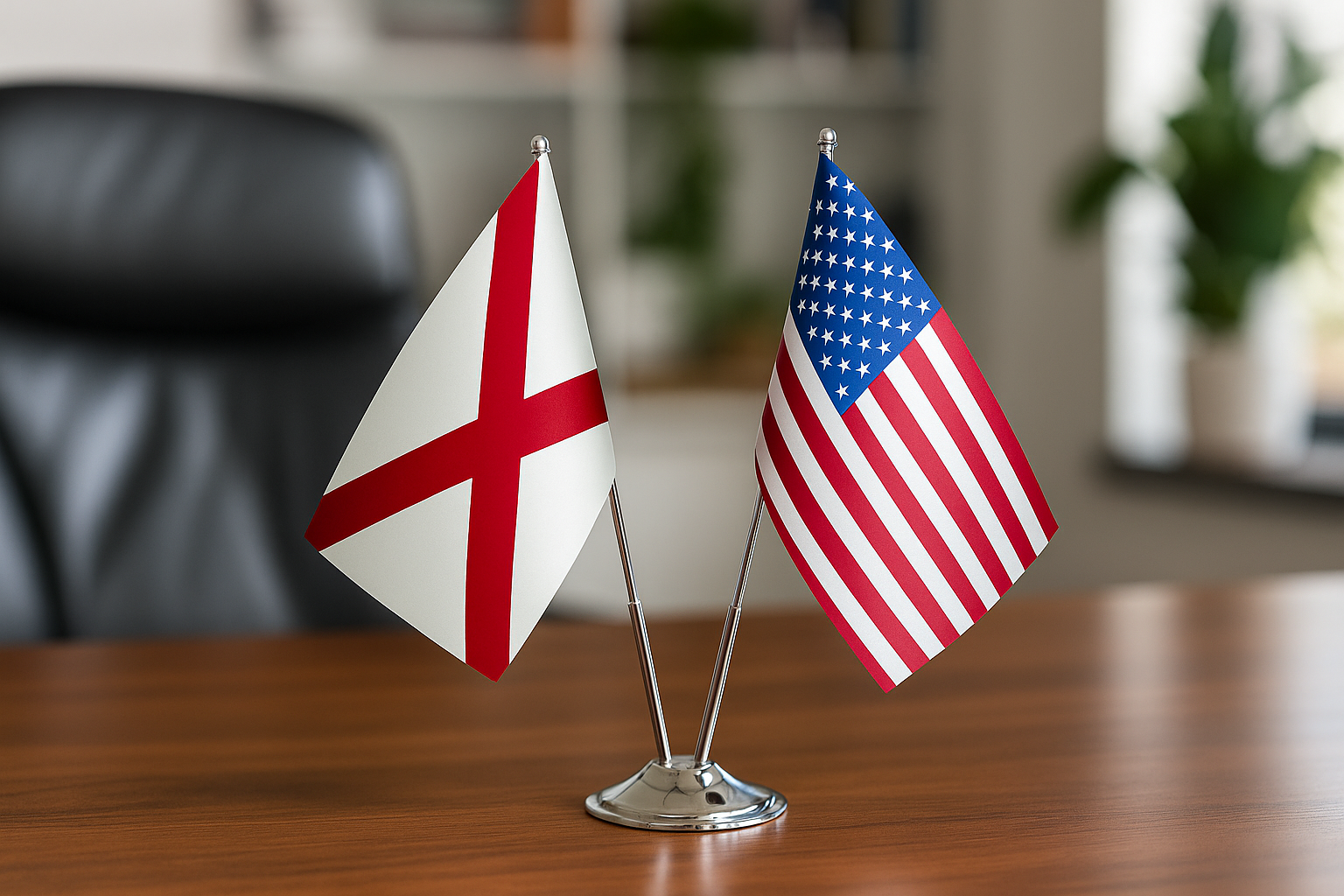
Rayon and two-ply polyester are the dominant materials for indoor ceremonial flags because both fabrics produce the rich, lustrous appearance expected in a formal government setting — they drape elegantly against a pole even without wind, whereas nylon tends to cling awkwardly indoors. Gold fringe (typically a 2.5 in / 6.4 cm fringe) is the traditional finishing detail for indoor ceremonial flags used by US government bodies; it is a military and governmental convention, not required by the Flag Code, but it is widely expected in council chambers and courtrooms at every level of government. Complete indoor ceremonial sets typically include the flag, a hardwood or solid-brass pole, an eagle or globe finial, and a weighted base — government procurement officers should confirm that all components are included in any quoted price to avoid surprise add-on costs. For municipalities that need the national, state, and city flags in matching sets — a very common requirement for city council chambers — coordinating all three through a single supplier ensures visual consistency in pole height, hardware finish, and fringe style. Browse the complete indoor flags collection to compare ceremonial sets and hardware options suited for public buildings of every size.
Government buyers should also consider the state and city indoor flags collection when specifying matching sets for their jurisdiction. Having the national, state, and municipal flag come from the same manufacturer guarantees that color calibration (particularly critical for state flags with complex seal designs), fringe weight, and pole diameter are all consistent — an important detail when flags are displayed side by side in a formal setting where visual asymmetry would be noticed.
Custom Logo and Municipal Emblem Flags for Public Buildings
Custom-printed municipal emblem flags are increasingly popular for government building flag display programs that want to reinforce civic identity alongside standard national and state flags. Modern dye-sublimation printing technology allows city seals, county emblems, departmental logos, and commemorative designs to be reproduced at full-color photographic quality directly onto flag fabric, with color accuracy that meets government brand standards without the color-bleeding issues associated with older screen-printing methods. Printed flags produced through dye-sublimation typically retain 85–90% of their original color saturation after 12 months of outdoor display, making them a cost-effective option for annual replacement cycles common in wholesale flags for municipalities programs.
When ordering custom emblem flags, procurement officers should provide vector artwork (AI, EPS, or high-resolution PDF files) at minimum 300 DPI at full print size to ensure clean reproduction at 3 ft × 5 ft (0.9 m × 1.5 m) or larger. Many municipalities also benefit from ordering a matching set of indoor and outdoor custom flags — an indoor dye-sublimation flag for the council chamber and an outdoor polyester version for the exterior pole — so the city emblem is consistently represented at every public-facing location. The logo-printed indoor flags collection offers custom emblem options specifically designed for formal indoor display, with the fringe finishing and hardware compatibility that government settings require.
Logo-Printed Outdoor Pole Flags
Custom municipal emblem and city seal flags built for outdoor flagpoles — available in bulk quantities with wholesale pricing for government accounts.
Browse Collection →Bulk Ordering Strategies for Municipal Procurement Departments
A well-structured municipal flags bulk order strategy saves procurement departments significant budget while ensuring consistent quality across all public buildings in a city or county system. The most effective approach groups all flag needs — outdoor pole flags, indoor ceremonial sets, and custom emblem flags — into a single annual or biannual purchase order, which unlocks volume pricing tiers and simplifies the vendor management workload for procurement staff. Most government suppliers, including wholesale manufacturers, offer price breaks at quantities of 12, 25, 50, and 100+ units; municipalities managing flags for a dozen or more locations should always request a formal volume quote rather than accepting catalog pricing.
Government procurement departments also benefit from establishing a standing vendor relationship with a manufacturer rather than going out to bid for every flag purchase. A master purchase agreement with a qualified flag supplier allows procurement officers to call off individual orders throughout the year at pre-negotiated pricing — a structure that accommodates unexpected needs like emergency replacements after storm damage, new building openings, or commemorative event flags — without triggering a new formal procurement process each time. Specify delivery lead times in any master agreement: standard production for in-stock national and state flags is typically 3–7 business days, while custom-printed municipal emblem flags require 10–21 business days depending on order quantity and artwork complexity.
Flagpole Hardware, Maintenance, and Replacement Scheduling
Government building flag display programs are only as effective as the hardware and maintenance schedule that supports them. Outdoor flagpoles for government buildings should be inspected quarterly: check the halyard (rope) for fraying, inspect pulley mechanisms for corrosion, verify that cleats and locking devices are functioning, and examine the truck (the cap assembly at the pole top) for damage that could cause the flag to foul. In coastal municipalities where salt air accelerates corrosion, monthly hardware checks are advisable. Flagpole halyards typically need replacement every 1–2 years for continuously flown flags; synthetic polyester rope or stainless-steel cable halyards outperform natural fibers in longevity and resistance to UV degradation.
For indoor ceremonial flags, the maintenance schedule is less intensive but still important for preserving the professional appearance expected in public settings. Indoor flags should be inspected monthly for dust accumulation, fringe tangling, and fabric fading from interior lighting — particularly fluorescent and LED sources with high UV output. Rayon ceremonial flags should be dry-cleaned rather than machine washed, and should be stored on their poles in a flag bag when the council chamber or courtroom is not in regular use. Establishing a documented replacement schedule — for example, replacing all outdoor flags at each public building every 9 months, and indoor ceremonial sets every 3–5 years — allows procurement departments to budget accurately and eliminates the reactive, emergency purchasing that is consistently more expensive per unit.
How to Place a Wholesale Government Flag Order
Wholesale flags for municipalities are straightforward to order when you come prepared with the right specifications. The first step is to inventory all flag display locations across your jurisdiction — noting pole height, flagpole diameter at the truck, indoor or outdoor environment, and whether custom emblem printing is required — so that a single comprehensive specification sheet can be submitted to the supplier. Having this document ready dramatically speeds up the quoting process and reduces the risk of ordering incorrect sizes. For bulk flags for public buildings orders, also confirm whether your jurisdiction requires specific country-of-origin documentation, material certifications (such as CPAI-84 for flame resistance in states that mandate it for public buildings), or vendor registration in your procurement system before a purchase order can be issued.
Government accounts typically qualify for net-30 or net-60 payment terms with an established supplier, which aligns with standard municipal accounts-payable cycles. Request a physical sample of each flag style and size before finalizing a large order — reputable manufacturers will provide samples, and confirming color accuracy, material weight, and construction quality before committing to a bulk purchase protects the procurement officer and the public budget. Communicate your delivery deadline clearly: many municipalities have specific installation dates tied to civic events, election cycles, or building openings where the flags must be in place.
What flag size is correct for a city hall outdoor flagpole? +
Does the US Flag Code apply to municipal and local government buildings? +
What is the best material for outdoor government flags in harsh weather? +
How long does it take to receive a municipal flags bulk order? +
What should a complete indoor ceremonial flag set include for a government office? +
Can municipalities order custom city seal or emblem flags in bulk? +
How often should government buildings replace their outdoor flags? +
Are wholesale pricing and net payment terms available for government flag orders? +
Managing a government building flag display program — from city hall outdoor pole flags to courthouse indoor ceremonial sets to custom municipal emblem flags for public buildings — is significantly simpler when you work with a single experienced wholesale supplier. Whether you need a one-time bulk replacement order or a standing procurement agreement that covers all flag-related needs across your jurisdiction, Asya Bayrak offers the product range, customization capability, and government-account pricing to serve municipal buyers of every scale. Start by reviewing the USA Outdoor Flag specifications for your exterior poles, explore the complete indoor flags collection for ceremonial chamber sets, and browse logo-printed outdoor pole flags for custom municipal emblem options. Bulk pricing is available for corporate and government orders — contact the Asya Bayrak team directly to discuss volume quotes, custom artwork requirements, master purchase agreements, and delivery scheduling for your municipality.


