




The Austria flag is one of the oldest national flags in the world, with its distinctive red-white-red horizontal triband traced back to at least 1230 AD — making it a strong contender for the title of the oldest continuously used flag design in history. This iconic banner has flown over the Habsburg Empire, two republics, and centuries of European political change, yet its essential design has remained remarkably unchanged. Whether you are a historian, a flag enthusiast, or planning to display it at an international event, understanding the Austrian flag history reveals far more than meets the eye. You can explore authentic, high-quality options in our European Countries Flags collection to display this storied symbol with the respect it deserves.
The Origins of the Austria Flag: A Legend Forged in Battle
The Austria flag's origins are most famously tied to a legend from the Battle of Ptolemais (Acre) in 1191, during the Third Crusade, where Duke Leopold V of Austria allegedly used his blood-soaked surcoat — white in the middle, red at the edges where his sword belt had been — as an improvised banner. While historians debate the literal truth of this story, the symbolic power it carries has made it central to Austrian national identity for over 800 years. The earliest verified documented use of the red-white-red combination dates to 1230, when it appeared in Austrian seals and heraldry, predating many of the world's most recognized national flags by several centuries.
What makes this origin especially remarkable is that the design was not imposed by a foreign power or adopted through revolution — it evolved organically from medieval heraldry into a formal national symbol. The Babenberg dynasty, which ruled Austria before the Habsburgs, was closely associated with the red-white-red motif, and it carried forward through each successive ruling house. By the time the Habsburg dynasty consolidated control over Central Europe in the 13th and 14th centuries, the triband was already deeply embedded in regional identity. This continuity across dynasties, republics, and even occupations is nearly unparalleled in vexillology — the academic study of flags.
Design and Specifications of the Austrian Flag
The Austria flag consists of three equal horizontal bands: red on top, white in the middle, and red on the bottom — a deceptively simple design that carries enormous historical weight. The official aspect ratio is 2:3, meaning a standard flag measuring 3 ft × 5 ft (approximately 90 cm × 150 cm) is the most common format for outdoor display, while 4 ft × 6 ft (120 cm × 180 cm) versions are often used on government buildings and formal poles.
 The colors of the Austrian flag are governed by specific national standards. The red used — sometimes referred to as "Austrian red" — is a vivid, medium-toned crimson, standardized at Pantone 032 C in international color specifications, ensuring consistency across government, military, and ceremonial use. The white band is pure, unadorned white with no embellishments on the civil flag. The Federal Republic of Austria does use a state version (the Dienstflagge) that features the Austrian coat of arms centered on the white stripe — an eagle with broken chains symbolizing freedom from fascist rule, a hammer and sickle representing workers and farmers, and a mural crown for civic life. For outdoor durability, the Austria Outdoor Flag from Asya Bayrak is manufactured with 80% UV-resistant polyester, offering an expected outdoor lifespan of 6 months to 2 years depending on weather exposure and pole conditions. Proper care, including periodic cleaning and indoor storage during storms, can extend that lifespan considerably.
Under FIAV (Fédération internationale des associations vexillologiques) standards, the civil flag (used by citizens) and the state flag (used by government entities) are formally distinguished. This distinction matters when choosing which version to display: private individuals, businesses, and event organizers typically use the plain triband civil flag, while government facilities display the coat-of-arms version. For most international sporting events, cultural celebrations, and diplomatic gatherings in the United States, the plain red-white-red triband is the appropriate and recognized choice.
What the Colors of the Austrian Flag Mean
The colors of the Austria flag — red and white — do not carry officially codified symbolic meanings in Austrian law, but centuries of interpretation have attached rich significance to them. Red is most commonly associated with courage, strength, and the blood of those who defended Austrian lands, while white traditionally represents peace, honor, and integrity in European heraldic traditions.
It is important to note that, unlike many modern flags designed with deliberate symbolism, the Austrian flag's colors emerged from medieval heraldry rather than a purposeful ideological framework. This distinguishes it from flags such as those examined in our post on what the colors on flags mean, where color choices were often made consciously to express political ideals. Austria's red-white-red combination predates the age of ideological flag design by several centuries, which is precisely what makes it so fascinating from a historical perspective. The meaning, in a sense, was built retrospectively — layered on top of a design that was originally purely heraldic in function.
The Habsburg Empire and the Flag Through the Ages
Under the Habsburg dynasty — which ruled Austria from the late 13th century until 1918 — the red-white-red banner took on an imperial dimension, representing one of the most powerful royal houses in European history. The Habsburgs controlled territories spanning modern-day Austria, Hungary, Czech Republic, Spain, the Netherlands, and much of the Americas at the height of their power, and the Austrian triband was flown alongside the imperial black-and-gold double eagle across this vast domain.
The flag's most significant modern transition came after World War I, when the Austro-Hungarian Empire collapsed and the First Austrian Republic was declared on November 12, 1918. The new republic adopted the traditional red-white-red triband as its national flag, stripping away the imperial insignia and returning to the simple, democratic expression of the original medieval design. This was a deliberate act of continuity — choosing a symbol that predated imperial rule to express a new democratic beginning. The flag was briefly suppressed during the Austro-fascist Dollfuss regime (1933–1938), which used a different banner, and again during the Nazi Anschluss period (1938–1945), when Austria was absorbed into the Third Reich. The restoration of the red-white-red flag in 1945 thus carried enormous emotional and political weight, representing liberation and the reestablishment of Austrian sovereignty.
European Countries Flags Collection
Explore our full range of European national flags, crafted for outdoor durability and accurate color representation for events, embassies, and collectors.
Browse Collection →How the Austrian Flag Compares to Similar Flags
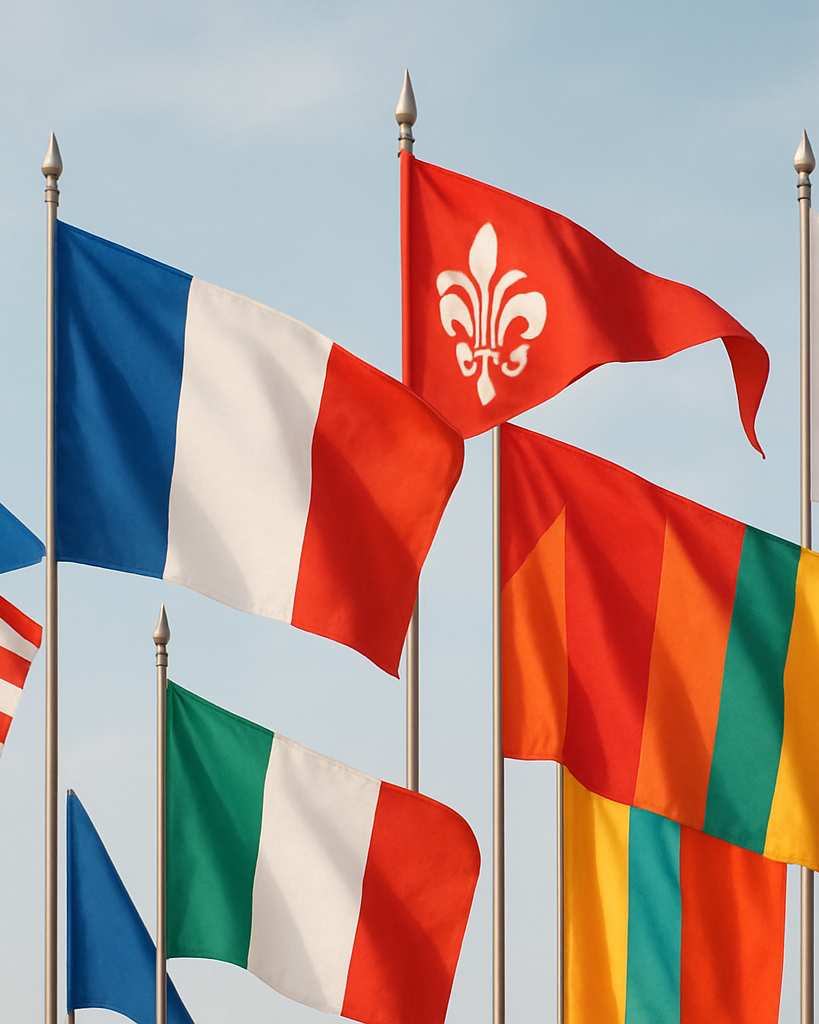
One of the most common points of confusion surrounding the austria flag is its similarity to the flags of Latvia and Singapore — and, with added elements, the flags of Poland and Indonesia. Latvia's flag is a dark maroon-white-maroon triband, distinguishable from Austria's by its deeper, wine-red hue and different proportions. Indonesia's flag is red over white (only two bands), while Poland's is white over red — the exact inverse of Austria's top stripe positioning, which can cause mix-ups at international events.
The key to visual identification is always the Austrian flag's three equal horizontal bands — red, then white, then red — combined with its 2:3 aspect ratio and the specific Pantone 032 C red shade. When flying alongside other flags, as is common at international trade fairs, diplomatic receptions, or sporting events in the United States, ensuring accurate color reproduction is critical to showing proper respect. If you are displaying flags from multiple nations, our broader Country Flags collection provides consistent quality and color accuracy across all nations, making multi-flag displays coherent and professionally presented. For those interested in how vertical display protocols affect flag identification, the guide on vertical country flags: when and how to use them is an excellent practical reference.
Displaying the Austrian Flag in the United States
When displaying the Austria flag in the United States, the US Flag Code (4 USC §§ 1-10) provides important guidance: when a foreign flag is flown alongside the US flag, both should be flown at the same height on separate staffs of equal size, and no foreign flag should be placed in a position of superior prominence to the American flag. The Austrian flag, like all foreign national flags, should always be flown at full staff unless official mourning protocols have been declared by the relevant government.
For outdoor use in the US, a 3 ft × 5 ft (90 cm × 150 cm) flag on a standard 20 ft to 25 ft (6 m to 7.6 m) aluminum or fiberglass pole is the most practical and proportionally appropriate setup for residential or business display. Commercial and institutional settings often opt for 4 ft × 6 ft (120 cm × 180 cm) or larger. Indoor ceremonial display — such as at Austrian cultural organizations, trade offices, or banquet halls — typically uses 3 ft × 5 ft flags on 8 ft (2.4 m) indoor poles with gold fringe and finials, which add a formal, dignified appearance appropriate for official occasions. It is worth noting that gold fringe on flags is purely ceremonial and carries no special legal or protocol significance under US or Austrian national codes.
Caring for and Preserving Your Austrian Flag
Proper maintenance significantly extends the lifespan of any outdoor flag, and the Austrian flag's bold red-white-red design requires particular attention to color preservation. Outdoor polyester flags exposed to direct UV radiation, rain, and wind typically have a lifespan of 6 months to 2 years; selecting a flag with UV-resistant treatment and double-stitched fly ends can add considerably to that range.
Washing should be done in cold water on a gentle cycle with mild, color-safe detergent — never bleach, which can strip the red pigment and cause white bands to yellow over time. Flags should be air-dried flat or hung loosely rather than placed in a dryer, which can cause shrinkage and distortion of the horizontal bands. During extended periods of non-use, store the flag rolled (not folded) in a cool, dry location away from direct sunlight to prevent creasing and UV degradation even in storage. Inspect the header (the reinforced sleeve or grommets along the hoist edge) regularly for wear, since this is the first area to fail under repeated wind stress — a reinforced canvas header with solid brass grommets is the hallmark of a professionally manufactured outdoor flag built for longevity.
How old is the Austria flag, and is it really the oldest national flag? +
What is the legend behind the Austrian flag's colors? +
What is the difference between the Austrian civil flag and the state flag? +
How do I tell the Austrian flag apart from similar flags like Latvia's or Poland's? +
What size Austrian flag should I buy for outdoor display in the US? +
Was the Austrian flag ever banned or changed during its history? +
How long will an outdoor Austrian flag last, and how should I care for it? +
The Austria flag is far more than a piece of colored fabric — it is a living document of nearly 800 years of European history, dynastic ambition, democratic revolution, and national resilience. Whether you are an Austrian expatriate, a European history enthusiast, a diplomat, or a business hosting international visitors, displaying this flag accurately and with care is a genuine mark of respect for one of the continent's oldest and most storied nations. For a durable, color-accurate option built for the demands of US outdoor conditions, the Austria Outdoor Flag from Asya Bayrak is an excellent choice. If you are building a broader international display, our complete Country Flags collection covers nations from every region with the same commitment to quality and accuracy. Bulk pricing is available for corporate orders, making it easy for hotels, event organizers, embassies, and multinational companies to outfit multi-flag displays professionally and cost-effectively.