








An indoor flag stand for an office or lobby needs to do three things well: hold the flag upright without tipping, suit the room's ceiling height, and look professional enough to represent your organization. Our Indoor Flags collection pairs every flag with a matching chrome metal pole and base so you get a complete, ready-to-display set — no guesswork, no mismatched hardware.
Which type of indoor flag stand actually fits your space
The right indoor flag stand depends on two things: the flag's finished size and the ceiling height of the room. For standard offices and lobbies with 8–10 ft (2.4–3.0 m) ceilings, a floor-standing base with an ornamental finial on top is the universal choice — it holds a 3 ft × 5 ft (91 cm × 152 cm) or 4 ft × 6 ft (122 cm × 183 cm) flag without crowding the room. If you are working with a soaring 12–16 ft (3.7–4.9 m) lobby atrium, a taller pole section or adjustable telescoping stand becomes necessary so the flag does not look lost near the floor. Tabletop indoor flag holders — small weighted bases designed for 4 in × 6 in (10 cm × 15 cm) desk flags — are a third format suited for conference tables and reception desks rather than ceremonial display. We cover pole heights and base dimensions in depth in our sibling article on indoor flagpole sets: heights and bases, so if you are still deciding on hardware dimensions, start there before choosing flags.
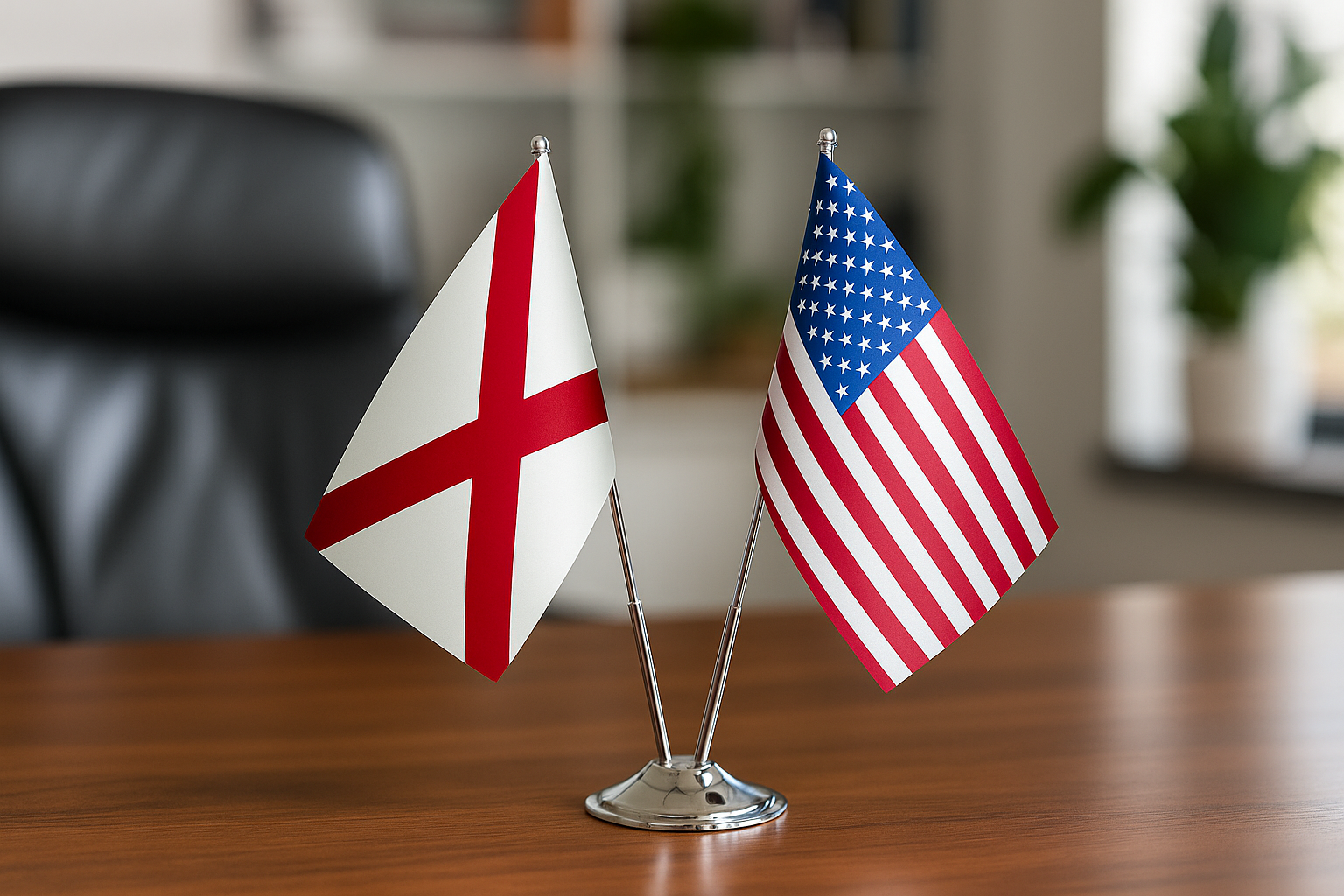
 Most professional indoor flag displays use a pole-and-base assembly where the base is weighted cast iron or heavy-gauge steel, measuring roughly 10–14 in (25–36 cm) in diameter, wide enough to prevent tipping even on hard floors. The flag attaches via a sleeve or header that slips over the pole — no clips or hardware to fumble with. Our Alabama Official Indoor Flag illustrates this setup clearly: the flag is built from double-layer satin fabric on a durable chrome metal pole, arriving as a complete display unit ready for state legislature halls, governor offices, courthouses, and public institutions. The crimson diagonal cross on white is reproduced via high-definition sublimation printing, so colors stay vivid under office fluorescent lighting without fading over time. If your space uses hardwood or tile floors, check that the base's feet have rubber pads to protect the surface and prevent any accidental sliding during daily foot traffic.
How many flag stands does your office or lobby actually need
Most offices need either one or three stands, almost never two. A single stand works for a private office or small conference room displaying a national flag alone. Three stands — national flag in the center, state flag on the right as you face the display, and an organizational or department flag on the left — is the most common ceremonial arrangement in US lobbies, following protocol under 4 USC § 7, which places the US flag at the position of honor. Two flags side by side can look unbalanced and tends to raise protocol questions about which flag takes precedence, so most institutional designers skip that configuration entirely. Larger facilities like hotel lobbies, court buildings, or corporate headquarters occasionally run rows of five or more stands, but that is a venue-specific decision driven by the number of stakeholders being recognized rather than a general rule.
How to lay out flag stands so they look intentional, not random
Position matters as much as quantity when setting up indoor flag poles and stands in a lobby or office. The US flag must always occupy the place of honor — to the flag's own right, which is the viewer's left when facing the display — per 4 USC § 7(e). When three flags are displayed in a straight row, the national flag goes in the center, slightly advanced forward if possible, with flanking flags set 6–12 in (15–30 cm) back and 18–24 in (46–61 cm) apart from one another. This slight forward offset creates a natural focal point and signals ceremonial intent rather than casual placement. Avoid placing indoor flag stands directly in front of windows: backlit flags wash out during daylight hours and the glare diminishes any sense of formality. For churches and houses of worship, the arrangement protocol has specific nuances discussed in our article on flags in church sanctuaries and fellowship halls.
 When a lobby features a curved reception desk or an asymmetrical floor plan, strict geometric spacing matters less than visual balance — step back and check from the main entrance angle, since that is the view visitors experience first. Corner placement can work well in smaller offices where floor space is limited: a single indoor flag holder placed in the corner behind a desk creates a dignified backdrop without occupying walking space. Our Alaska Official Indoor Flag, for example, features the iconic gold Big Dipper and North Star on a deep blue field via high-definition sublimation printing and comes on a chrome metal pole, making it immediately presentable in a corner arrangement for Alaskan state offices, courthouses, or any institution recognizing Alaska's heritage. The double-layer satin construction means the flag drapes smoothly even without air movement, which is essential in still indoor environments where a limp, stiff flag would look unkempt. When combining multiple flags in a hallway display, keep all pole heights identical so no single flag appears subordinate to another — mixed heights send an unintentional hierarchy signal.
What you should budget for a complete indoor flag pole and stand setup
A single complete indoor flag pole and stand set — flag, pole sections, finial, and base — typically costs more than buying the components separately but saves significant assembly time and guarantees that hardware and flag sizes are matched correctly. Budget considerations break into three layers: the flag itself, the hardware, and optional accessories like a carrying case or replacement finials. The flag's complexity drives most of the cost: a standard national or state flag on satin with sublimation printing is priced for institutional budgets, while custom-embroidered or gold-fringed ceremonial flags command a premium. For a three-stand lobby display covering the US flag, one state flag, and one organizational flag, plan for three complete sets rather than mixing sources — mismatched pole finishes and base styles look noticeably inconsistent in a formal lobby environment.

Indoor Flags Collection
Complete pole-and-base sets for every national, state, and country flag — ready for offices, embassies, lobbies, and institutional spaces.
Browse Collection →Accessories add to the total but deliver real value. A chrome or gold-tone finial eagle costs more than a plain ball finial, but in a federal building or embassy setting the eagle is effectively required by convention. Replacement tassels and fringe trim are low-cost additions that extend the life of an aging display without replacing the full set. If your organization is purchasing for multiple offices across several floors or locations, bulk pricing is worth requesting — consistent hardware and flags across all installations make a facility look coordinated rather than assembled piecemeal. For anything involving country flags beyond the US, the Country Indoor Flags collection covers diplomatic and international display needs.
When to place your order so flags arrive before your event or opening
Order your indoor flag stands and flags at least 3–4 weeks before any hard deadline — grand openings, inspection dates, or formal ceremonies — to absorb production and shipping time comfortably. Standard production on printed satin indoor flags runs 5–10 business days, with shipping adding 2–5 business days depending on destination within the continental US. Custom flags with embroidery, special finials, or non-standard sizes require longer lead times, often 3–6 weeks from artwork approval to delivery. The most common mistake organizations make is ordering flags the week before an event and then discovering that a custom element — a specific state seal, an organization's coat of arms, or a particular fringe color — requires extra production time. If your display involves a mix of standard national or state flags and one custom organizational flag, order the custom piece first and use its estimated delivery date as your planning anchor. For offices that rotate displays seasonally or update flags after political transitions, building a small standing inventory of replacement flags avoids the last-minute scramble entirely; our separate guide on when to replace an indoor flag outlines exactly what warning signs indicate a flag is due for replacement so you can order ahead of that moment.
What is the standard size for an indoor flag pole? +
Does an indoor flag pole and stand come as a complete set or do I buy them separately? +
What is the correct indoor flag holder for a desk versus a lobby? +
What indoor flags work best for official government or embassy settings? +
How should I display the US flag alongside a state flag indoors? +
Can I use an indoor flag display setup for a temporary event or trade show? +
How long do indoor flags last before needing replacement? +
Setting up a flag display that looks genuinely professional comes down to choosing matched, complete sets rather than assembling mismatched components from different sources. For a standard office or lobby, start with the USA Official Indoor Flag as your anchor piece, add the relevant state or organizational indoor flag from our full collection, and use our indoor flagpole sets guide to confirm the right pole height for your ceiling before ordering. For international or diplomatic offices displaying foreign flags alongside the US flag, the Country Indoor Flags collection offers matching-format sets for virtually every nation. Bulk pricing is available for corporate, government, and institutional orders covering multiple offices or facilities — contact us directly to discuss volume requirements and lead times.


