
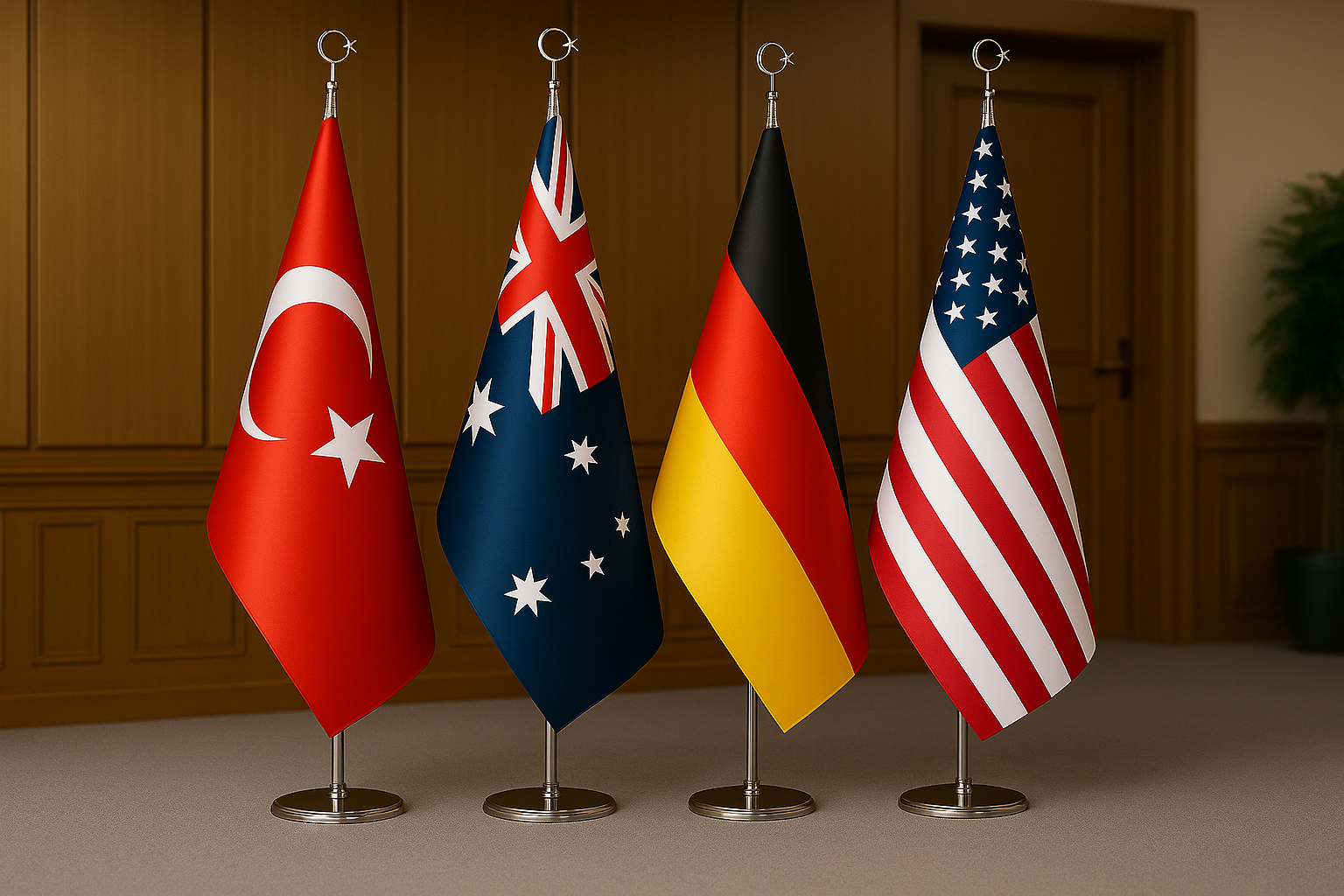
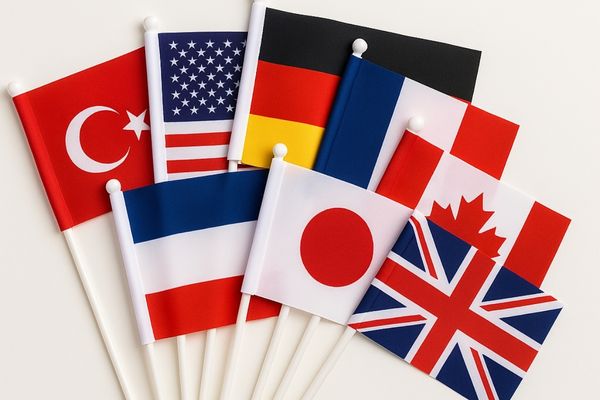
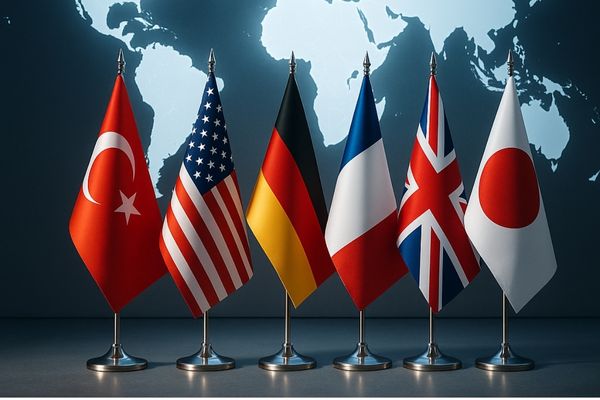



At least 30 countries and territories feature a crescent moon on their national flag, with the largest concentration found across the Middle East, North Africa, and Central Asia. Browse the full range in our MENA Countries Flags collection to find officially proportioned flags for nearly every nation in the region. The crescent is one of the most globally recognized flag symbols, yet its meaning, origin, and design vary significantly from one country to the next — this guide covers all of it in one place.
What the Crescent Moon Symbol Means on a Flag
The crescent moon on a flag most commonly represents Islam, but its precise symbolism depends on the country — for some it signals sovereignty, for others celestial guidance or a pre-Islamic heritage. Understanding the difference matters, because not every crescent flag belongs to a Muslim-majority nation, and not every Muslim-majority nation uses the crescent at all.
In the Ottoman tradition, the crescent and star together represented divine favor and imperial power, a meaning carried forward by Turkey, Pakistan, and several other successor states. In Malaysia and Mauritania, the crescent specifically references the lunar Islamic calendar. Singapore's crescent, by contrast, appears on a flag of a majority-Buddhist and secular nation; its government defines it as a symbol of a young nation on the rise, not as a religious emblem. Libya uses the crescent in stark isolation — white on black — as a deliberate statement of Islamic identity following the 2011 revolution. The shape itself matters too: FIAV (Fédération Internationale des Associations Vexillologiques) standards note that Ottoman-style crescents typically open to the right (dexter), while some newer national designs use left-opening or upward-opening variants depending on artistic convention.
A Brief History of the Crescent on Flags
The crescent's presence on flags dates to at least the 13th century, when it appeared on Byzantine and then Ottoman battle standards — making it one of the oldest continuously used symbols in vexillology. Its global spread followed the expansion of Ottoman influence across three continents over roughly 600 years.
Before the Ottomans, the crescent was a civic symbol of Constantinople (modern Istanbul), associated with the goddess Artemis/Diana and visible on city coins as early as the 4th century BCE. When Mehmed II captured the city in 1453, the symbol was absorbed into Ottoman iconography and gradually acquired Islamic connotations in the eyes of both Muslim and European observers. By the 18th and 19th centuries, European cartographers were routinely using the crescent as a shorthand icon for the Ottoman Empire and its vassal states on atlases and diplomatic maps. After World War I dismantled the Ottoman state, the newly independent nations that emerged — Turkey (1923), Iraq (1921), and others — inherited the symbol and adapted it to their own identities. The 20th century added a second wave: post-colonial nations in Africa and Asia, from Mauritania (adopted its flag in 1959, updated in 2017) to Malaysia (1963), chose the crescent to signal their Muslim-majority character to the world.
Every Country Whose Flag Carries a Crescent Moon
 The countries most commonly listed as crescent-flag nations fall into four geographic clusters: the Middle East and North Africa, Sub-Saharan Africa, South and Southeast Asia, and Central Asia. In the Middle East and North Africa, the clearest examples are Turkey (white crescent and star on red), Tunisia (red crescent and star on white disk, red field), Libya (white crescent and star on all-black), Algeria (red crescent and star, white and green), Egypt (the Eagle of Saladin on its coat of arms includes a crescent in some historic renditions, though Egypt's current flag does not feature one directly), Morocco (green pentagram — no crescent), and Comoros (white crescent with four stars on green). Mauritania deserves special mention: its 2017 constitutional revision added two horizontal red bands to the traditional green-and-gold design, but the bold gold crescent and star at the center remain intact — you can order a precision-manufactured version from our Mauritania Outdoor Flag page. The Sub-Saharan African group includes Senegal and Djibouti (star, no crescent), while Mauritania and the Comoros stand out as the continent's clearest crescent-flag examples. In Asia, Pakistan, Malaysia, Maldives, Brunei (crescent within royal arms), Uzbekistan, Turkmenistan, and Azerbaijan all feature the crescent prominently.
Here is a concise reference list organized by region:
- Middle East & North Africa: Turkey, Tunisia, Libya, Algeria, Comoros, Western Sahara (SADR — unrecognized), Mauritania
- South & Southeast Asia: Pakistan, Malaysia, Maldives, Brunei (within the national crest), Singapore
- Central Asia: Uzbekistan, Turkmenistan, Azerbaijan
- Notable sub-national flags: Northern Cyprus (unrecognized state), several Malaysian state flags, and the flags of numerous provinces in Pakistan and Indonesia
 Singapore's flag is perhaps the most frequently misread crescent flag in the world — it is secular, not Islamic, and the crescent is officially described as representing a young nation ascending, paired with five white stars symbolizing democracy, peace, progress, justice, and equality. The flag was adopted on December 3, 1959, when Singapore was a self-governing British colony, and has remained unchanged since independence in 1965. The bicolor design (red over white, split horizontally at 1:2 ratio) is strictly regulated under the Singapore Arms and Flag and National Anthem Act; reproducing it incorrectly is a legal offense in Singapore itself. For diplomatic offices, cultural events, or educational displays in the United States, our Singapore Outdoor Flag is manufactured to the official proportions and printed with UV-resistant inks rated for 6 months to 2 years of outdoor exposure depending on climate. If you are sourcing flags for international events and need a broader selection, our Country Flags collection covers virtually every sovereign nation.
Crescent Flags That Are Frequently Confused With Each Other
Turkey and Tunisia are the pair most commonly mixed up: both use a red field with a white crescent and star, but Turkey's crescent opens slightly more and the star is smaller relative to the crescent, while Tunisia's design centers the emblem inside a white circle. Pakistan's crescent is often confused with Algeria's — both use a green field with a crescent and star — but Pakistan's background is solid dark green with a white vertical stripe on the hoist side, while Algeria's is split vertically between white and green.
Libya's all-black field with a solitary white crescent and star is unique among current national flags, yet people sometimes confuse it with historical versions of the Egyptian or Sudanese flags. Mauritania's flag is occasionally mixed up with Saudi Arabia's due to the shared green field and Arabic religious symbolism, but Saudi Arabia's flag uses the Shahada (Islamic declaration of faith) and a sword — no crescent. Comoros features a crescent alongside four stars representing its four main islands; the crescent points toward the fly (right side), whereas most other nations' crescents point toward the hoist. If you are trying to identify an unfamiliar crescent flag, checking the field color, star count, and crescent orientation together will eliminate most ambiguity.
Where the Crescent-and-Star Pairing Comes From
The star paired with the crescent is not a Quranic symbol — it has no direct basis in Islamic scripture and was absent from early Islamic empires. Its pairing emerged primarily as Ottoman court iconography, possibly adopted from earlier Byzantine, Sassanid Persian, or Hellenistic astronomical traditions.
Scholars at FIAV and in academic vexillology generally trace the combined motif to 14th–15th century Ottoman military standards, where the star (often an eight-pointed or five-pointed form) was used alongside the crescent on banners and coins. As the Ottoman Tanzimat reforms of the 19th century standardized state symbols, the crescent-and-star combination was formalized on the Ottoman flag around 1844 — the direct ancestor of modern Turkey's flag. European colonial powers recognized it as the symbol of Ottoman suzerainty, so newly independent Muslim-majority nations that emerged in the 20th century adopted it partly to signal civilizational belonging. The five-pointed star now predominates on most crescent flags, though Comoros uses four stars, and some historical flags used an eight-pointed version. For a parallel exploration of how other non-obvious national symbols developed their meaning, our related article on why the Albania Flag looks the way it does offers a useful comparison in European vexillology.
Official Flag Sizes and Display Standards for Crescent Flags in the US
In the United States, displaying a foreign crescent flag is governed by custom and the US Flag Code (4 USC §§ 1–10) only insofar as it prohibits displaying a foreign flag above the US flag on American soil. Beyond that, each nation's own regulations define the official proportions and color specifications.
Standard outdoor flags sold in the US market typically come in 3 ft × 5 ft (91 cm × 152 cm) and 4 ft × 6 ft (122 cm × 183 cm) sizes, which suit most residential and commercial flagpoles of 15–25 ft (4.5–7.6 m) height. Turkey's official flag ratio is 2:3; Pakistan's is 2:3 as well; Malaysia's is 1:2; and Singapore's is 2:3. When purchasing for diplomatic, consular, or United Nations display, always verify the official aspect ratio of the specific country, since displaying a flag in the wrong proportions can be considered disrespectful under that nation's own flag laws. Our manufacturing process references FIAV-documented proportions for each nation, and all outdoor products use header-and-grommet construction with brass grommets rated for continuous outdoor use.

MENA Countries Flags
Officially proportioned outdoor flags for every nation in the Middle East and North Africa — the world's highest concentration of crescent-flag countries.
Browse Collection →Frequently Asked Questions About Crescent Flags
Is the crescent moon on flags always an Islamic symbol? +
Which crescent flag has the most unusual or unexpected design? +
Does Saudi Arabia or Iran have a crescent on their flag? +
Which direction does the crescent open on most national flags? +
What is the correct Pantone or color spec for Turkey's red flag? +
Can I display a crescent-flag country's flag above a US flag on American soil? +
What fabric is best for crescent flags used outdoors in hot, sunny climates? +
Whether you are sourcing a single flag for a cultural event or placing a bulk order for a government installation, the key is matching the correct proportions, color specifications, and fabric to the specific crescent-flag nation you need. Explore our MENA Countries Flags collection for the widest selection of Middle Eastern and North African crescent flags, or browse the full Country Flags collection for Singapore, Pakistan, Malaysia, and every other crescent-flag nation worldwide. For in-depth flag symbolism from other regions, our article on Flags of Oceania: Island Nations Explained applies the same rigorous approach to a completely different part of the world. Bulk pricing is available for corporate, diplomatic, and institutional orders — contact us directly for a quote.