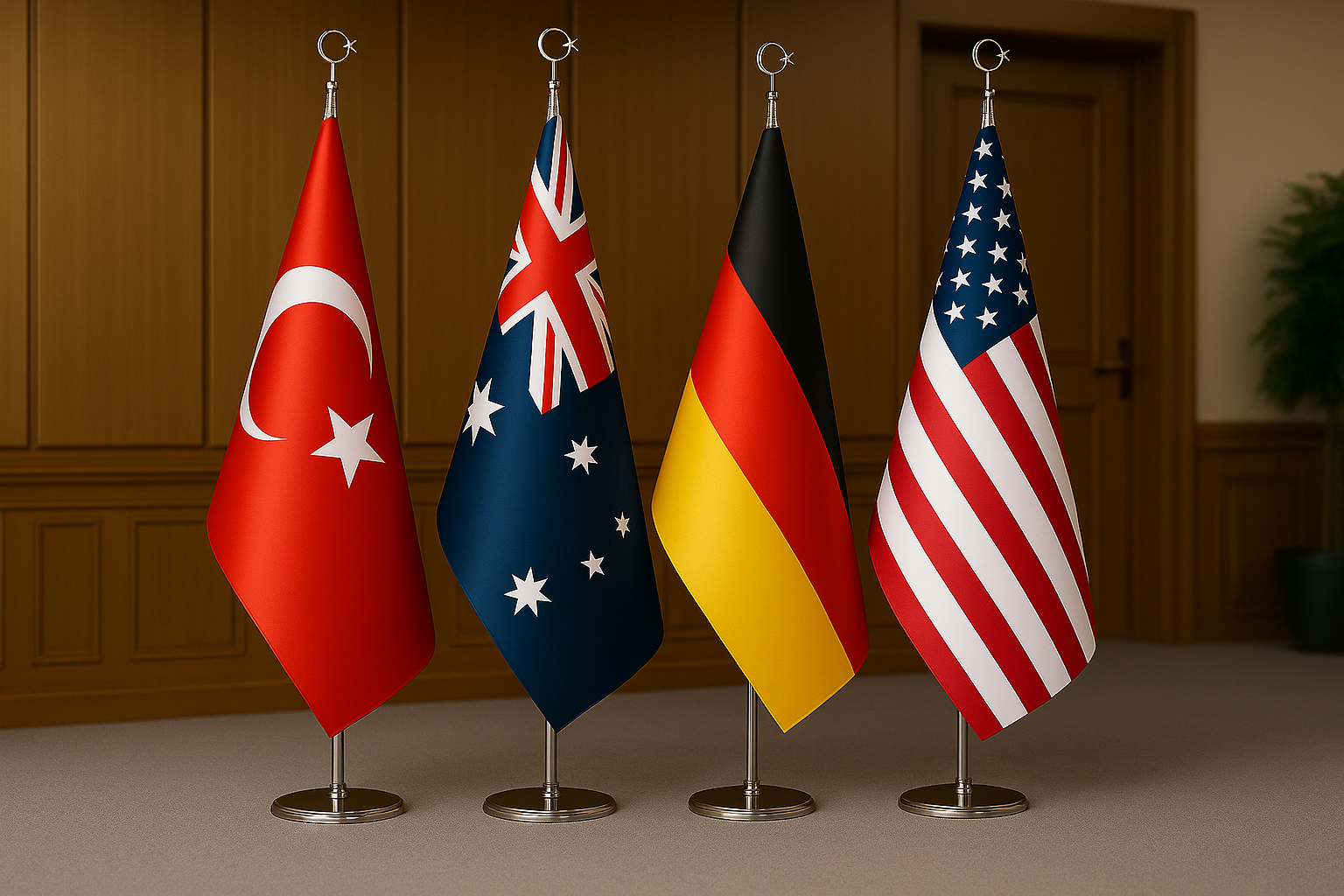



The three primary flagpole base types are ground-sleeve (in-ground) bases, plastic (water or sand-fill) bases, and sand-embedding devices — each designed for a distinct installation environment and portability requirement. Choosing the right flag pole stand type determines not only how securely your flag flies, but also whether your setup complies with site regulations, withstands local wind loads, and can be relocated when needed. For a comprehensive overview of mounting hardware options, the Bases & Stands collection at Asya Bayrak covers the full range of commercial-grade solutions.
Ground-Sleeve (In-Ground) Bases: Maximum Stability for Permanent Installations
A ground-sleeve base is the most stable flagpole base option available, anchored in concrete 18–36 in (46–91 cm) below grade and capable of supporting poles 20–80 ft (6–24 m) tall in sustained winds exceeding 90 mph (145 km/h). This type is the industry standard for government buildings, municipal facilities, schools, and commercial campuses where the pole is intended to remain in one position indefinitely. For context on how these standards apply in civic settings, see the detailed guide on outdoor flagpole flag sets for government buildings and municipal facilities.
Installation typically involves augering a cylindrical hole, setting a steel or aluminum sleeve, and pouring a concrete footing that extends at least 6 in (15 cm) below the frost line for your climate zone — critical in northern US states where freeze-thaw cycles can heave improperly anchored footings. The pole then drops into the sleeve and is secured with a set screw or wedge, making future pole replacement or inspection straightforward without breaking concrete. Load ratings for sleeve-based systems are governed by ANSI/NAAMM FP 1001, the industry's primary flagpole engineering standard, and most commercial-grade sleeves are engineered for 150% of the rated wind load to provide a safety margin.
For large commercial or government installations, sleeve diameter must match pole butt diameter precisely — common commercial sizes run from 3 in (7.6 cm) for residential poles up to 8 in (20 cm) for monumental installations. The sleeve itself is typically 24–48 in (61–122 cm) long and made from Schedule 40 galvanized steel to resist soil corrosion. If your site has clay-heavy or waterlogged soil, extended sleeves with drainage holes or a gravel bed beneath the footing are strongly recommended to prevent water pooling and accelerated corrosion at the base of the pole shaft.
Plastic Fillable Bases: Portable, Versatile, and Event-Ready
Plastic fillable flagpole bases are the go-to flag pole stand type for any situation where portability matters — they ship lightweight, set up without tools, and gain ballast by filling with water (roughly 8.34 lb/gallon, 1 kg/liter) or sand (approximately 100 lb/ft³, 1,600 kg/m³). This makes them indispensable for trade shows, retail showrooms, car dealerships, open houses, outdoor events, and any commercial location where a permanent ground installation is not permitted or practical.
 The 19 Lt Plastic Base is a prime example of commercial-grade portable flagpole bases, offering a 19-liter (approximately 5 US gallons) capacity that delivers meaningful ballast weight once filled. When filled with sand rather than water, a 19-liter base holds roughly 55–60 lb (25–27 kg) of ballast, providing stable support for banner poles and feather flags in outdoor settings with moderate wind exposure. The wide, low-profile footprint distributes weight effectively, reducing the tipping moment that affects taller, narrower bases. These plastic units are UV-stabilized to resist sun degradation through an entire outdoor season, and most include a screw-cap fill port that makes draining and refilling straightforward for venues that relocate displays frequently. For event coordinators managing multiple display points, the ability to ship units empty and fill on-site with locally sourced sand is a significant logistical and cost advantage.
One practical consideration for commercial buyers: sand-filled plastic bases outperform water-filled ones in outdoor environments because water can freeze in winter conditions (freezing point 32°F / 0°C), which may crack the container shell. Sand remains inert at any temperature, making it the preferred fill for year-round outdoor use. When deploying plastic bases indoors — in convention centers or showrooms — water fill is perfectly suitable and eliminates the mess of sand handling on polished floors. Most commercial-grade plastic bases accommodate pole diameters from 1 in to 1.5 in (25–38 mm), which covers the full range of feather flag and banner pole shafts in common use.
Sand-Embedding Devices: Ground-Penetrating Portability for Soft Surfaces
A sand-embedding device (also called a ground spike or sand anchor) is the correct flag pole stand type for soft substrates — beach sand, grass, athletic fields, unpaved event grounds, and landscaped areas — where neither concrete nor a surface-sitting base is appropriate. These devices typically feature a helical or serrated spike that is twisted or driven 8–18 in (20–46 cm) into the substrate, with a receiving socket at grade level that accepts the flagpole or banner pole shaft.
 The Sand Embedding Device from Asya Bayrak is engineered specifically for this use case, with a robust spike geometry that bites into compacted sand or soft earth and resists pull-out forces generated by flag wind loads. Installation takes under two minutes without any tools beyond what the device itself provides, making it ideal for beach events, sports competitions, and promotional pop-ups where setup speed is critical. The socket at the top is precisely sized to receive standard banner and feather flag poles without wobble, keeping the flag vertical and visually sharp. Because the spike is fully removable, it leaves no permanent mark on the ground — an important consideration for event venues, parks, and beaches with permit restrictions on ground modifications. For buyers planning beach or coastal deployments, the companion guide on how to choose a beach flag base covers substrate-specific selection criteria in depth, including wave wash zones and wind exposure ratings by coastal region.
Sand-embedding devices perform best in substrates with at least moderate cohesion — damp beach sand holds a spike far more reliably than dry, loose dune sand, and firm lawn soil provides excellent resistance to lateral forces. In very loose or dry substrates, using a longer spike (12–18 in / 30–46 cm) or pre-wetting the insertion point can significantly improve hold. Wind load is the primary engineering concern with spike-type anchors: a typical feather flag measuring 8 ft (2.4 m) tall generates lateral forces of 15–35 lb (7–16 kg) in a 20–30 mph (32–48 km/h) wind, which a properly seated spike in damp sand handles comfortably.
Poles & Holders Collection
Complete flagpole and holder systems matched to commercial and event display needs — browse the full range to find the right pole and base pairing for your installation.
Browse Collection →Comparing the Three Base Types: A Practical Decision Framework
The right flagpole base for any project comes down to three variables: permanence, surface type, and wind exposure. Ground-sleeve bases win on structural load capacity and permanence; plastic fillable bases win on portability and surface protection; sand-embedding devices win on speed of deployment in soft substrates. Understanding where each type excels prevents both over-engineering (costly, over-built for temporary use) and under-engineering (a portable base used in a location that demands a permanent installation).
Consider permanence first. If your flag will fly at the same location for more than one year, a concrete-anchored ground sleeve is almost always the correct solution — the higher upfront installation cost is offset within one season by eliminated restocking, damage replacement, and repositioning labor. If your display moves even quarterly, a portable solution (plastic base or spike) becomes the economical choice. Surface type is the second filter: hard surfaces (concrete, asphalt, tile) require a surface-sitting base like a plastic fillable unit, since there is no substrate to penetrate. Soft surfaces (sand, turf, compacted earth) open the door to spike-type anchors, which are more stable than surface-sitting bases in exposed outdoor environments because their center of gravity is at or below grade.
Wind exposure is the third and most safety-critical variable. The US Flag Code (4 USC §§ 1–10) does not specify base engineering, but local building codes in many jurisdictions do — particularly for permanent installations over 20 ft (6 m). For commercial real estate and leasing office contexts where brand-consistent flag displays must perform reliably across seasons, the article on outdoor branded pole flags for real estate developments provides useful guidance on matching base type to site conditions and flag sizing.
Installation Tips and Maintenance Best Practices for Each Base Type
Proper installation and routine maintenance can double the functional lifespan of any flagpole base, regardless of type. Ground sleeves should be inspected annually for corrosion at the soil-to-air interface — this transition zone is where galvanic corrosion concentrates — and any surface rust should be treated with a zinc-rich primer before it progresses to pitting. Plastic bases should be drained and stored above freezing when temperatures consistently drop below 32°F (0°C) to prevent freeze-cracking of the container shell, which typically costs more to replace than it would have cost to drain the unit before winter.
For sand-embedding devices, the primary maintenance task is rinsing with fresh water after any coastal or beach deployment, since saltwater accelerates corrosion on the metal spike body. Most commercial-grade spikes are made from galvanized or zinc-coated steel, which offers good salt resistance, but a fresh-water rinse followed by light oil application on the threads or joints ensures a long service life. Periodically check the socket at the top of the spike for deformation — repeated removal and reinsertion of poles can gradually widen the socket opening, which leads to pole lean. If you're evaluating complete flag and pole kits that include base hardware, the guide on feather flag pole kits and what's actually included clarifies what base hardware typically ships with kit purchases versus what must be sourced separately.
Bulk Ordering Considerations for Commercial Flagpole Base Purchases
Commercial buyers — event companies, municipalities, real estate developers, trade show organizers — routinely order flagpole bases in quantities of 20 to 500+ units, and at that scale, specification consistency, unit weight, and packaging density become as important as per-unit price. Plastic fillable bases are the most logistics-friendly option in bulk, shipping flat-nested or stacked at roughly 3–5 lb (1.4–2.3 kg) per unit empty, with fill materials sourced locally at the destination. This dramatically reduces freight costs compared to pre-weighted alternatives.
Sand-embedding devices are similarly compact in bulk shipments, with the spike profiles allowing efficient pallet packing. Ground-sleeve hardware (steel sleeves plus anchor bolts and cover plates) ships heavier but in smaller quantities per project since each unit serves a permanent installation. When specifying bases for a multi-site commercial rollout — for example, a national retail chain standardizing on a single flag display system across 150 locations — Asya Bayrak's bulk pricing structure allows volume discount tiers that significantly reduce per-unit cost. The Bases & Stands collection pages provide specifications needed for procurement documentation, including dimensions, materials, and compatible pole diameters.
Frequently Asked Questions
What is the difference between a plastic flagpole base and a sand-embedding device? +
Is it better to fill a plastic flagpole base with water or sand? +
How deep does a ground-sleeve flagpole base need to be installed? +
Can a plastic flagpole base be used outdoors in winter? +
What pole diameter do most plastic and sand-embedding bases accommodate? +
Are sand-embedding devices reusable across multiple events? +
Which flagpole base type is best for a trade show or indoor event? +
Do local building codes regulate flagpole base types for commercial installations? +
Selecting the right flagpole base is a straightforward engineering decision once you know your surface type, portability requirements, and wind exposure. For portable commercial and event use, the 19 Lt Plastic Base delivers reliable ballast in a ship-light format, while the Sand Embedding Device is the correct choice for any soft-ground or beach deployment. The full range of commercial hardware — including permanent ground hardware and mounting accessories — is available through the Bases & Stands collection and the Poles & Holders collection. Bulk pricing is available for corporate, municipal, and event-company orders — contact Asya Bayrak directly to discuss volume pricing, specification sheets, and project-specific recommendations for multi-site deployments.