


Outdoor flags for churches, nonprofits, and houses of worship serve as powerful visual statements of identity, mission, and community presence — and choosing the right size, material, and display setup makes the difference between a flag that lasts through every season and one that fades or tears within months. Whether you are outfitting a single congregation entrance or ordering bulk outdoor flags for nonprofits across multiple locations, the right purchasing decisions start with understanding flagpole height, wind exposure, fabric durability, and local display regulations. This guide walks faith communities and mission-driven organizations through every key decision, from selecting a standard 3x5 flag for church use to planning a full house of worship flag display that honors your organization's values and withstands the elements.
Why Outdoor Flags Matter for Nonprofits and Religious Organizations
Outdoor flags are among the most cost-effective visibility tools available to nonprofits and houses of worship, signaling your presence to the surrounding community every single day without recurring advertising costs. A well-chosen flag communicates openness, stability, and mission at a glance — before a visitor even steps through your doors.
For faith communities in particular, the flag display area outside a church, mosque, synagogue, or temple is often the first physical impression a visitor receives. Studies in nonprofit marketing consistently show that visible, professional exterior signage — including flags — increases foot traffic and volunteer inquiries. Unlike printed banners, which typically have a lifespan of 3–6 months outdoors, purpose-built outdoor flags for churches and nonprofits made from marine-grade nylon or polyester can last 6 months to 2 years depending on climate and UV exposure. Organizations that invest in quality flagpole flags for community organizations find they spend less on replacements and more on their actual mission. If your nonprofit or congregation is ready to make a lasting impression, browsing the full flags collection at Asya Bayrak is an excellent starting point for comparing styles, sizes, and materials side by side.
Choosing the Right Flag Size for Your Flagpole and Property
The correct flag size is determined primarily by your flagpole height — the general industry rule is that flag length should equal approximately one-quarter to one-third of the flagpole height. For most church and nonprofit properties with standard 20 ft (6.1 m) to 25 ft (7.6 m) flagpoles, a 3x5 ft (0.9 x 1.5 m) or 4x6 ft (1.2 x 1.8 m) flag is the ideal choice.
A 3x5 flag for church use is the single most popular size ordered by religious organizations and small nonprofits because it balances visibility with manageable cost, especially when ordering in volume. For larger campuses — community centers, megachurches, or nonprofit headquarters with flagpoles reaching 40 ft (12.2 m) or taller — a 5x8 ft (1.5 x 2.4 m) or even 6x10 ft (1.8 x 3 m) flag provides the proportional visual weight needed to be seen from the street. It is also worth noting that under the US Flag Code (4 USC §§ 1-10), if you display the American flag alongside your organizational flag, the US flag must be at least as large as and flown at the same height or higher than any other flag. Many houses of worship choose to fly their organizational flag on a separate pole of equal height to honor this requirement while still giving their own flag equal prominence. Consider measuring your existing flagpole carefully before ordering, and account for setback distance from the road — a flag that reads clearly at 50 ft (15.2 m) is far more effective than one that is oversized and difficult to raise in wind.
 Flagpole flags designed for outdoor use must be engineered to handle continuous exposure to wind, rain, and UV radiation — three forces that degrade lesser materials rapidly. The canvas header, which is the reinforced strip sewn along the hoist edge of the flag, should be made from heavy-duty duck canvas with two or more rows of lock-stitching to prevent tearing at the grommets, which are the metal rings used to attach the flag to a halyard rope. Brass or stainless steel grommets resist corrosion far better than standard zinc versions, an important detail for organizations in coastal or high-humidity climates. For outdoor flag for religious organizations that fly their flags year-round, UV-stabilized inks and solution-dyed fabrics maintain color vibrancy up to 80% longer than surface-printed alternatives. You can explore the full range of flagpoles and accessories to ensure your display hardware matches the quality of your flag investment.
Best Materials for Outdoor Flags in Church and Nonprofit Settings
Nylon is the single best outdoor flag material for most church and nonprofit applications because it is lightweight, dries quickly after rain, and produces vivid color output — all while delivering a lifespan of 6 months to 2 years under regular outdoor exposure. Polyester is the preferred choice when wind speeds are frequently high, as its heavier weave resists tearing far better than nylon in sustained gusts.
Understanding the material differences matters enormously when you are placing bulk outdoor flags for nonprofits across multiple properties or planning an annual purchasing cycle. Here is a straightforward comparison:
- 2-ply nylon: Best for light-to-moderate wind regions. Vibrant color, fast-drying, ideal for visual events and seasonal campaigns. Weight: approximately 200 gsm.
- Heavy-duty polyester (300D): Best for coastal, open-field, or high-wind environments. Superior tear resistance, slightly muted color compared to nylon. Weight: approximately 300–350 gsm.
- Knitted polyester mesh: Excellent for flagpoles in wind-prone regions. The open weave allows wind to pass through, dramatically reducing stress on the header and grommets and extending flag life by 30–50% compared to solid fabric in the same conditions.
- Digitally printed canvas: Suitable for decorative outdoor use near entrances or on shorter display poles, but not recommended for high-flagpole use in variable weather.
For most nonprofit organization flags meant to fly continuously outdoors, we recommend specifying UV-resistant, lock-stitched nylon for properties in the Midwest, Southeast, and Mid-Atlantic regions, and shifting to 300D polyester for locations in the Pacific Northwest, Great Plains, or coastal zones where sustained wind speeds above 20 mph (32 km/h) are common. Always ask your supplier about the specific gsm (grams per square meter) rating and whether inks are solution-dyed or surface-printed — this single detail has the largest impact on long-term color retention.
Planning Your House of Worship Flag Display: Layout and Protocol
A well-planned house of worship flag display considers not only aesthetics but also the legal and customary protocols that govern flag placement in the United States, including the US Flag Code and any local municipal ordinances that regulate flag pole height and proximity to public roads. Getting these right the first time prevents costly relocations and community complaints.
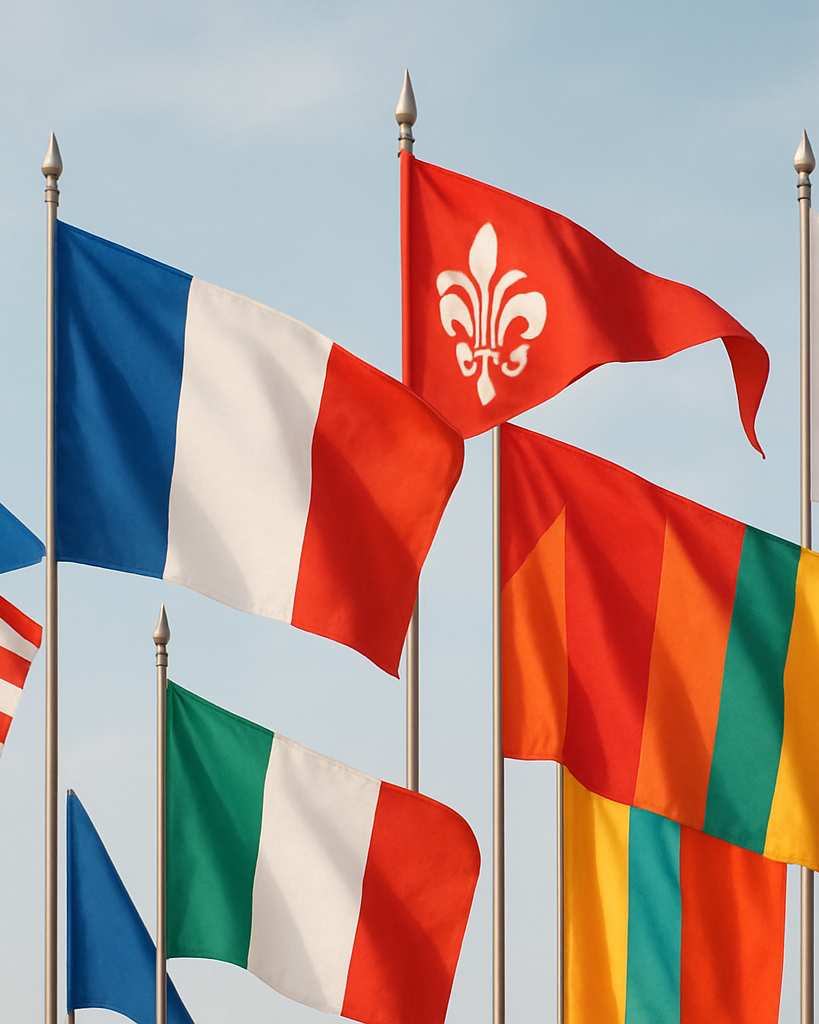
 When designing a multi-flag outdoor display for a church campus or nonprofit headquarters, the most common configuration is a three-pole arrangement: the center pole flies the US flag at the highest point, while the left pole (from the viewer's perspective facing the building) flies the state flag and the right pole displays the organizational or denominational flag. This layout follows standard FIAV (Fédération internationale des associations vaxillologiques) display conventions and aligns with US Flag Code guidance on proper flag precedence. If your property can only support a single pole, the organizational flag should fly below the US flag on the same halyard, with the US flag always at the peak. Many faith communities also choose to display indoor presentation flags in their sanctuaries and meeting halls alongside the outdoor display — the indoor flags collection offers ceremonial options specifically designed for interior use with floor stands and altar placements. Setback from the property line, pole foundation depth (typically 10–15% of pole height below grade), and local HOA or zoning ordinances should all be verified with your municipality before installation, as violations can result in fines or required removal.
Lighting is a detail often overlooked until after installation. Under the US Flag Code, the American flag may be displayed 24 hours a day only if it is properly illuminated during darkness — a rule that applies equally to any display where the US flag is present. Solar-powered LED flag lights have become a practical and cost-effective solution for nonprofits and churches, eliminating the need for electrical conduit runs to the flagpole base. For organizations in northern states that experience winter daylight hours as short as 8–9 hours, timer-controlled LED systems ensure compliance without staff having to manually raise and lower the flag at sunrise and sunset.
Flagpoles & Accessories Collection
Complete your outdoor display with the right hardware — from heavy-duty commercial flagpoles to halyards, snap hooks, and solar flag lights designed for year-round nonprofit and religious organization use.
Browse Collection →Bulk Ordering Strategies for Nonprofits and Faith Networks
Nonprofits and faith networks with multiple locations consistently save 20–40% per unit by placing consolidated bulk outdoor flag orders rather than purchasing site by site through retail channels. Centralizing your purchasing also guarantees color consistency and material standardization across all your properties — a critical factor for organizations with established brand guidelines or denominational standards.
When planning a bulk order of flagpole flags for community organizations, start by auditing every location's flagpole height and condition at least 90 days before your target installation date. This window allows time for custom printing, quality review, and shipping without rushed timelines that can compromise quality. Create a master specification sheet that captures: flag size, material type, grommet material, header type, ink specification (UV-resistant, solution-dyed), and any custom artwork requirements such as logos, scripture references, or mission statement text. For faith networks ordering across multiple states, it is worth confirming that your flag dimensions and any flagpole heights comply with local signage ordinances, as some municipalities classify flags above a certain size as regulated signage requiring permits. Many national denominational bodies — including Catholic dioceses, United Methodist conferences, and Baptist associations — have begun establishing centralized flag procurement programs that leverage group buying power and ensure all member congregations display flags that meet the same visual standards. If your organization falls into this category, ask your flag supplier about tiered volume pricing, drop-ship logistics to multiple addresses, and dedicated account management, all of which can dramatically simplify the administrative burden of a multi-site rollout.
Maintenance, Replacement Cycles, and Caring for Your Outdoor Flags
Even the highest-quality outdoor flags for churches and nonprofits have a finite service life — plan on replacing nylon flags every 6–12 months in high-wind or coastal environments and every 12–24 months in moderate climates with periodic indoor storage during severe weather. Regular inspection and simple maintenance practices can extend flag life by 30–50% and keep your display looking sharp between replacement cycles.
Establish a monthly flag inspection routine as part of your facility maintenance checklist. Look for fraying along the fly end (the edge opposite the flagpole), fading especially along fold lines where UV exposure is concentrated, and any signs of tearing or grommet pull-through at the header. Flags showing fraying of more than 1 in (2.5 cm) along the fly edge should be retired and replaced immediately, as frayed edges accelerate tearing exponentially in wind. Washing nylon or polyester flags in cold water with mild detergent — never bleach — and allowing them to air dry completely before re-raising removes salt, grime, and biological matter that degrades fabric over time. Organizations in areas with frequent thunderstorms or ice storms should take flags down and store them indoors during severe weather events, a practice that alone can double the usable life of a standard outdoor flag. For organizations that retire flags, the US Flag Code recommends dignified disposal, typically by burning in a private ceremony — many American Legion and VFW posts offer flag retirement ceremonies that nonprofits and churches are welcome to participate in, making this final step a meaningful community moment rather than simply a disposal task.
Frequently Asked Questions
What is the best flag size for a church with a 20 ft flagpole? +
Can a religious organization fly its own flag above the American flag? +
How long do outdoor flags last for nonprofits and churches? +
What material is best for an outdoor flag in a high-wind location? +
Do nonprofits need a permit to install a flagpole on their property? +
Can we print custom logos or scripture on outdoor flags for our church? +
How do we retire or dispose of an old outdoor flag properly? +
What is the minimum order quantity for bulk outdoor flags for nonprofits? +
Equipping your nonprofit, church, or house of worship with the right outdoor flags is an investment that pays dividends every day your doors are open — and every day they are not. Start by exploring the USA Outdoor Flag product page for durable, UV-resistant options ready for flagpole display, or browse the complete flags collection to compare sizes and materials across the full catalog. If your organization also holds indoor ceremonies, services, or events, the indoor flags collection offers ceremonial presentation flags with matching stands to complete your display program inside and out. Bulk pricing is available for corporate and organizational orders — contact the Asya Bayrak team to request a custom quote for your denomination, nonprofit network, or multi-campus faith community and ensure every location projects the same quality and mission-driven identity you work hard to uphold every day.