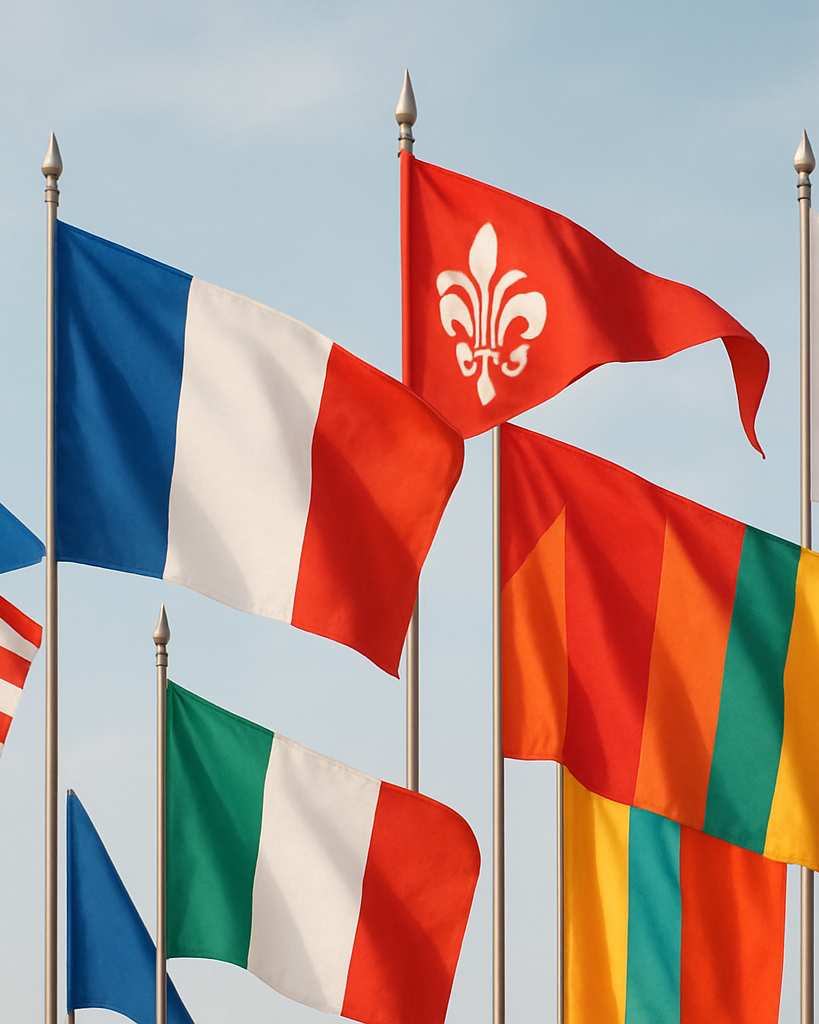




The flags of Africa represent 54 sovereign nations, each carrying a rich layered vocabulary of color, symbol, and history that reflects the continent's struggle for independence, its cultural heritage, and its vision for the future. African country flags are among the most symbolically dense in the world — nearly every stripe, star, crescent, and color carries deliberate meaning rooted in pan-African philosophy, religious identity, or geographic reality. Whether you are a student, educator, event planner, or flag enthusiast, understanding what these flags represent deepens appreciation for one of the world's most diverse continents.
You can explore and order authentic flags from across the continent through the African Countries Flags collection, where every flag is produced to accurate proportions and vivid color specifications for indoor display, outdoor use, and large-scale events.
The Pan-African Color Tradition: Red, Gold, and Green
The single most influential color tradition in African vexillology is the pan-African palette of red, gold, and green — a combination that appears, in some form, on the flags of more than a dozen African nations. This tradition traces directly to the Ethiopian flag, one of Africa's oldest and most symbolically powerful banners. Ethiopia's resistance to colonial conquest made it a beacon for the Pan-African movement of the early 20th century, and its colors — red for the blood of those who defended the land, gold for the wealth and mineral richness of Africa, and green for the fertile land and the hope of the future — were consciously adopted by newly independent states as a declaration of solidarity.
Ghana, which became the first sub-Saharan African country to gain independence in 1957, was among the first to formally adopt the pan-African palette. Kwame Nkrumah's government added a black five-pointed star at the center — the Black Star of Africa — representing the lodestar of African freedom. This star became so iconic that it gave Ghana its football team its nickname. Mali, Guinea, Senegal, Cameroon, and many others drew from the same well, sometimes reordering the stripes, sometimes adding central emblems, but consistently signaling their place within a pan-African identity. Understanding this color grammar is the first key to reading African country flags with real comprehension.
Symbolism in Stripes: What Horizontal and Vertical Arrangements Mean
The orientation of stripes on African flags is rarely accidental — vertical stripes often signal a French colonial heritage and the influence of the French tricolor, while horizontal stripes more commonly reflect British colonial design traditions or indigenous compositional choices. France's influence on its former territories in West and Central Africa is visible in the vertical tricolor format adopted by countries such as Mali, Guinea, Côte d'Ivoire, Cameroon, and Senegal. This is not simply stylistic imitation; in many cases, these nations deliberately modified the French tricolor's colors to assert their own identity while retaining a format familiar in diplomatic and international contexts.
 Senegal's flag is a masterclass in concentrated symbolism packed into a simple vertical tricolor. The three stripes run green, gold, and red from left to right — colors drawn directly from the pan-African tradition — with a five-pointed green star centered in the gold stripe. Green represents Islam, the faith of approximately 95% of Senegal's population, as well as hope and the land's fertility. Gold symbolizes wealth, the arts, and the country's natural resources, while red stands for the blood of those who fought for independence and the strength of the Senegalese people. The central green star, added at independence in 1960, reinforces the Islamic connection and signals Senegal's unity. For institutions displaying this flag at multicultural events or educational settings, the Senegal Outdoor Flag is produced in durable 200-denier nylon with UV-resistant inks for long-lasting outdoor display.
Horizontal stripe flags in Africa often carry their own symbolic logic. Tanzania's flag is particularly notable: a black diagonal stripe edged in gold cuts across the flag from lower-left to upper-right, separating a green upper-left triangle from a blue lower-right triangle. The diagonal itself is unusual in African vexillology and reflects Tanzania's formation from the union of Tanganyika and Zanzibar. Mozambique's flag goes even further — it incorporates a crossed hoe and rifle overlaid on an open book, placed over a red triangle, making it one of the few national flags in the world to feature a firearm. Understanding the geometry of African flags is inseparable from understanding the political histories that shaped them.
Stars, Crescents, and Central Emblems Across the Continent
Central emblems — stars, crescents, suns, eagles, and coat-of-arms devices — appear on more than half of all African country flags and carry some of the most specific national meaning of any element. Stars are by far the most common emblem: they appear on the flags of Ghana, Senegal, Morocco, Libya, Djibouti, Somalia, and many others, each with different symbolic freight. A star may represent unity, a guiding ideal, a religious identity, or the stars of a national coat of arms.
 Cameroon's flag offers one of the most elegant examples of star symbolism among African country flags. Its vertical tricolor of green, red, and yellow follows the pan-African palette, with a single gold five-pointed star centered in the red stripe. The star represents the unity of the country — specifically, the union of French Cameroun and British Southern Cameroons in 1961, which created the modern state. Green on the left represents the country's southern forests and fertility; red in the center stands for unity and the sovereign authority of the state; yellow on the right evokes the savannahs of the north and the country's natural wealth. The flag's clean design, with no additional coat of arms or complex emblem, makes its single star all the more powerful as a national statement. The Cameroon Outdoor Flag is available in standard 3 ft × 5 ft (91 cm × 152 cm) sizing, sewn with reinforced fly-end stitching for wind resistance in outdoor environments.
Crescents and stars together appear on North African flags — most notably Morocco, Tunisia, Libya, Mauritania, and Algeria — reflecting the Islamic identity of these nations. The crescent moon is one of the most globally recognized symbols of Islam, and its presence on a national flag is an explicit declaration of state religion or cultural majority. Morocco's flag is distinct among these: it uses a solid red field (one of the oldest flag colors in the Arab world, representing the Alaoui dynasty) with a green pentagram — the Seal of Solomon — at its center. Green in Islamic tradition represents paradise, and the pentagram's five points correspond to the five pillars of Islam. Algeria's flag divides equally between green and white, with a red crescent and star at the center — red here representing the blood of those killed during the French colonial period and the struggle for independence.
Flags Reflecting Geography, Wildlife, and Natural Heritage
Several African country flags move beyond political and religious symbolism to incorporate direct references to the physical landscape, wildlife, or geographic identity of the nation. These flags use imagery that is immediately legible even to those unfamiliar with the country's history, grounding national identity in the natural world. Kenya's flag, for example, places a Maasai warrior's shield and two crossed spears at its center — a direct reference to the cultural heritage of one of Kenya's most prominent ethnic groups, as well as a symbol of the defense of freedom. The shield's design is drawn from authentic Maasai craft traditions.
Zimbabwe's flag features the Zimbabwe Bird — a representation of the soapstone sculptures found at the ancient city of Great Zimbabwe — in white, placed over a red star on a black triangle. The Zimbabwe Bird is one of the most powerful symbols of pre-colonial African civilization on any national flag. Uganda's flag carries a grey crowned crane, the country's national bird, in a white circle at the center. South Africa's flag, redesigned in 1994 to mark the end of apartheid, uses a unique Y-shaped green stripe that converges at the fly end, incorporating six colors — black, gold, green, white, red, and blue — representing the diversity of the nation's population without assigning each color to a specific group. These flags demonstrate that African vexillology is not formulaic; it is a genuinely creative tradition that draws on the full range of national experience.
How Flags Changed After Independence: Revisions and Political Transitions
Many African country flags have been revised — sometimes multiple times — to reflect political change, regime transitions, or post-conflict reconciliation, making the history of these flags as dynamic as the history of the continent itself. Libya alone has used at least four distinct national flags since independence in 1951, most recently returning to the independence-era tricolor of red, black, and green with a white crescent and star after the 2011 revolution. Ethiopia's flag has changed its central emblem multiple times, currently displaying a blue disk with a golden sun and rays, reflecting successive changes in government and state ideology.
Rwanda redesigned its flag entirely in 2001, abandoning the previous design — which was associated with the 1994 genocide — for a new tricolor of blue, yellow, and green with a golden sun symbol in the upper-right corner. The sun represents enlightenment and transparency; the blue symbolizes happiness and peace; the yellow stands for economic development; the green represents hope and the country's natural prosperity. This deliberate act of vexillological revision is one of the most striking examples in the world of a flag being used as an instrument of national healing and forward projection. For event planners, educators, and institutions working with delegations from African nations, understanding which flag version is current is essential — always verify against official government sources or trusted suppliers before ordering.
African Countries Flags Collection
Accurate, professionally manufactured flags for all 54 African nations — available in outdoor nylon and indoor polyester, sized for poles, podiums, and large-venue display.
Browse Collection →Displaying African Flags: Protocols, Sizing, and Practical Guidance
When displaying flags of Africa at events, embassies, schools, or conference venues, following correct protocol respects both the host nation and the visiting delegation or community. African nations each maintain their own flag codes, though most follow broadly similar principles to international diplomatic norms: flags should be displayed at the same height as other national flags when shown together, should never touch the ground, and should be kept in clean and undamaged condition. In multi-flag displays featuring both African and other international flags, the flags are typically arranged alphabetically by country name in the language of the host nation.
Standard outdoor flag sizing for national flags in the United States follows the 1:1.9 ratio common to most UN-member nation flags, with the most widely used size being 3 ft × 5 ft (91 cm × 152 cm) for pole mounting. Indoor and podium flags typically run 4 ft × 6 ft (122 cm × 183 cm) on a pole with ornamental finial. For large international events — Model UN conferences, trade summits, multicultural festivals — flags are often displayed at 4 ft × 6 ft (122 cm × 183 cm) or even 5 ft × 8 ft (152 cm × 244 cm) to ensure visibility across a hall. Organizers planning multi-nation African flag displays will find detailed guidance in our article on international flag display kits for conference centers and multi-nation event venues, which covers sizing, hardware, and bulk ordering logistics. Educational institutions running African studies programs or multicultural campus events may also find value in the guidance on country flags for Model UN conferences and international student offices.
Frequently Asked Questions
Why do so many African flags use red, gold, and green? +
Which African country flag is considered the oldest? +
What does the color white represent on African country flags? +
How many African countries have a star on their flag? +
Which African flag changed most recently and why? +
What is the correct size for displaying African flags at international events? +
Are there flags of Africa that do not use the pan-African colors at all? +
The flags of Africa tell 54 distinct national stories through a shared vocabulary of color, geometry, and symbol — stories of liberation, faith, geography, wildlife, cultural pride, and hard-won sovereignty. From the pan-African tricolors of West Africa to the crescent-and-star banners of the North and the wildlife-emblem flags of the East, African country flags constitute one of the world's richest bodies of vexillological design. Whether you are outfitting a Model UN conference, a multicultural school campus, a trade summit, or a diplomatic reception, displaying these flags accurately and respectfully matters. You can order professionally manufactured flags for all 54 African nations through the African Countries Flags collection, or browse the full range of world flags in the Country Flags collection. Individual country flags such as the Senegal Outdoor Flag and the Cameroon Outdoor Flag are available in durable 200-denier nylon with UV-resistant color printing rated for 6 months to 2 years of continuous outdoor exposure depending on climate conditions. Bulk pricing is available for corporate, diplomatic, and institutional orders — contact us with your flag list and quantities for a custom quote.