


The Haiti flag is a bicolor banner of blue and red with a central white panel bearing the national coat of arms — a symbol of the world's first Black republic and the first nation born from a successful slave rebellion. Known in French as the drapeau Haïti, this flag carries more than two centuries of revolutionary history, Indigenous symbolism, and hard-won sovereignty in every thread. Whether you are a researcher, a diaspora community member, or an event organizer seeking an authentic Haiti outdoor flag, understanding what this banner represents deepens the respect it deserves.
The Origins of the Haiti Flag: A Revolution Stitched in Color
The Haiti flag was born on May 18, 1803, at the Congress of Arcahaie, when revolutionary leaders formally tore apart a French tricolor and sewed its blue and red bands together — deliberately discarding the white stripe that symbolized French colonial rule. That foundational act of creation was not just ceremonial; it was a declaration that a new people, defined by their shared struggle rather than by European hierarchy, would build their own nation. The legend credits Catherine Flon, a goddaughter of independence leader Jean-Jacques Dessalines, with physically sewing the two bands together, making the drapeau Haïti one of the few national flags with an identifiable creator at its birth. Haiti declared full independence on January 1, 1804, becoming the first Black republic in the world and the first country in the Western Hemisphere to abolish slavery permanently. The flag's creation just months before that independence date makes it inseparable from the Haitian Revolution itself, a 13-year armed uprising against French colonial rule and the institution of slavery.
Haiti Flag Colors: What Blue and Red Symbolize
The blue and red of the Haiti flag each carry specific national meanings that have been reaffirmed through multiple constitutional revisions. Blue represents the union of Haitians of African descent — solidarity, the sky, and the ocean that both isolated and connected the island to the wider world. Red represents the blood shed by those who fought and died in the revolution, as well as the fire and courage of the Haitian people. Together, the two colors echo the Pan-African spirit that would later influence flags across the Caribbean and continent of Africa. Interestingly, the arrangement of the stripes has changed over Haiti's turbulent political history: the current constitution calls for blue on top and red on the bottom when the flag is displayed horizontally, though this order was reversed to red-over-blue during certain regimes, including the Duvalier dictatorship. The bicolor design is deceptively simple — its power comes entirely from its history rather than from complexity of design. For organizations looking to display the flag correctly alongside others, guidance on orientation and protocol can be found in our article on vertical country flags: when and how to use them.
The Coat of Arms: Decoding the White Panel
 The central white rectangle of the drapeau Haïti houses the national coat of arms, which is arguably one of the most information-dense emblems in all of Caribbean heraldry. At its core is a royal palm tree standing atop a green hilltop — the palm symbolizes independence, resilience, and the unconquerable spirit of the Haitian people, who believe that like the palm, they bend under pressure but do not break. Flanking the palm are six Haitian flags arranged in two groups of three, reinforcing the national banner's prominence within the national identity itself. A cannon sits at the base of the palm, surrounded by cannonballs, an anchor, and other military equipment, honoring the armed struggle that made independence possible. Draped across the bottom of the emblem is a white ribbon bearing Haiti's national motto: L'Union Fait La Force — "Unity Makes Strength" — a phrase that has resonated with Haitian communities worldwide for over two centuries. The coat of arms was formalized in 1807 under Alexandre Pétion and has undergone refinements but has remained structurally consistent, making it one of the more stable heraldic elements in a flag history otherwise marked by frequent change. If you are sourcing a flag for official or ceremonial use, the Haiti outdoor flag faithfully reproduces these details with precision printing.
A Timeline of Change: How the Flag Evolved Over 200 Years
The Haiti flag has gone through at least eight distinct official versions since 1803, reflecting the country's turbulent political shifts more transparently than almost any other national flag in the Americas. The very first flag after the Congress of Arcahaie was a simple horizontal bicolor without any emblem at all. When Jean-Jacques Dessalines declared himself Emperor Jacques I in 1804, he altered the flag to black over red, representing the Black and mixed-race populations who had fought together. Under Henri Christophe's kingdom in the north of the island, the flag changed again, and under Alexandre Pétion's republic in the south, yet another version emerged — this time closer to the modern design, with blue over red and the new coat of arms. The reunification of Haiti under Jean-Pierre Boyer in 1820 eventually stabilized the design, though reversals continued well into the twentieth century. The most recent constitutional reaffirmation of the blue-over-red horizontal bicolor with the central coat of arms dates to the 1987 constitution, which is the governing standard today. This long history of visual change makes the Haiti flag a living document of the nation's political biography — each version reflecting who held power and what ideals they wished to project. Comparable in complexity to the rich heraldic traditions of other former colonial nations, the drapeau Haïti shares thematic DNA with other flags born from liberation movements, a subject explored more broadly in flags of Africa: meanings and symbols.
The Haiti Flag and the Haitian Diaspora
The drapeau Haïti functions as far more than a state symbol — for an estimated 1.5 to 2 million Haitians living in the United States alone, it is a badge of cultural identity and collective memory. Haitian Flag Day, celebrated on May 18 each year, is observed with particular intensity in cities like Miami, New York, and Boston, where large Haitian-American communities organize parades, cultural festivals, and public ceremonies centered on the flag. The date commemorates the 1803 Congress of Arcahaie and has been an official holiday in Haiti since 1803, making it one of the oldest national flag observances in the Western Hemisphere. In the United States, the display of the Haiti flag at schools, community centers, and public events is fully protected expressive conduct under the First Amendment, though organizers displaying it alongside American flags should follow US Flag Code (4 USC §§ 1-10) guidelines on relative placement — the US flag should remain in the position of honor when on American soil. Community organizations, cultural centers, and Haitian restaurants frequently order flags in bulk for Flag Day events, and durable outdoor-rated flags are particularly in demand during spring months when outdoor festivities are planned.
Americas Country Flags Collection
Explore flags of every nation in the Americas — from Canada to Argentina — manufactured to outdoor-grade standards for events, institutions, and cultural celebrations.
Browse Collection →How to Display the Haiti Flag Correctly
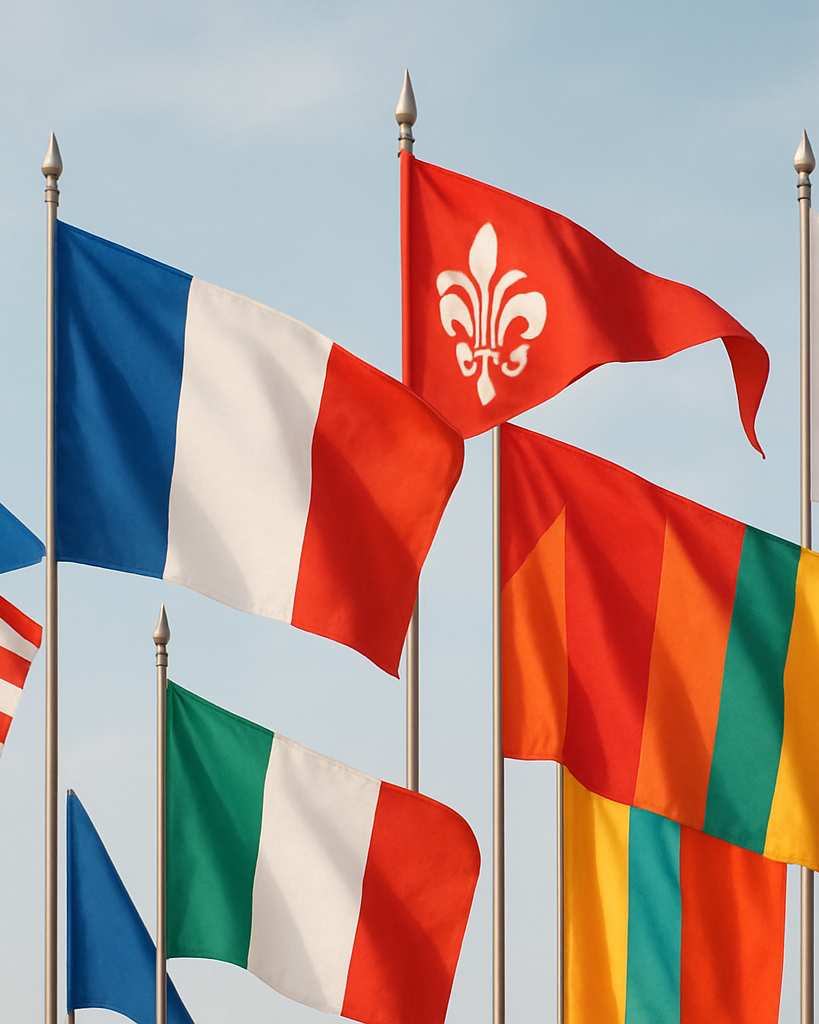
Correct display of the Haiti flag requires attention to stripe orientation, the coat of arms panel, and relative positioning when shown alongside other national flags. Under Haiti's 1987 constitution, the official flag has blue on top and red on bottom, with the white coat of arms panel centered on the flag's horizontal axis — this is the version used for all formal state, diplomatic, and civic purposes. A plain bicolor version (without the coat of arms) is sometimes used at sea as a civil ensign, but for land-based display — whether at a cultural event, an embassy, or a school — the coat of arms version is always correct. Standard outdoor flag sizes in the United States commonly range from 3 ft × 5 ft (91 cm × 152 cm) for residential poles to 4 ft × 6 ft (122 cm × 183 cm) and 5 ft × 8 ft (152 cm × 244 cm) for commercial flagpoles. FIAV (Fédération internationale des associations vexillologiques) standards recommend that when flags of multiple nations are displayed together, all flags should be the same size and flown at equal height, with no single national flag raised above another — a protocol especially important for international events, conference centers, and sports venues. Materials matter for longevity: a quality outdoor flag made from 100% SolarMax nylon or heavy-duty polyester will resist UV degradation and provide a lifespan of 6 months to 2 years depending on wind exposure, compared to 2–4 months for low-grade printed alternatives. Our full country flags collection offers options across multiple sizes and materials to match any display requirement.
Interesting Facts About the Drapeau Haïti
Beyond its history and symbolism, the Haiti flag holds several distinctions that make it genuinely unique among world flags. It is the only national flag in the world that features another national flag within its own coat of arms — the six miniature Haitian flags arranged on either side of the palm tree are depicted on the very flag they embellish, creating a recursive visual motif found nowhere else in vexillology. Haiti's flag also influenced the design of the flags of Liechtenstein (which similarly uses a horizontal bicolor) and, more directly, inspired the Pan-African color movements of the twentieth century, as Haiti was already a symbol of Black liberation long before those movements formally organized. The Congress of Arcahaie story — where the white stripe of the French tricolor was ripped out and the blue and red were sewn together — is one of the most dramatic founding myths of any national flag, placing the act of flag-making directly in the middle of armed revolutionary action. The motto L'Union Fait La Force was also adopted by Belgium in 1830 in its French-language form, making it a rare instance where the same national motto appears on two completely unrelated flags from different continents and different centuries. These layers of meaning and connection make the drapeau Haïti a compelling object of study for anyone interested in the intersection of history, politics, and visual identity.
Frequently Asked Questions
What do the colors of the Haiti flag mean? +
When was the Haiti flag created? +
What does the coat of arms on the Haiti flag represent? +
Is blue on top or on the bottom in the official Haiti flag? +
What is Haitian Flag Day and when is it celebrated? +
How many times has the Haiti flag changed throughout history? +
What size Haiti flag should I buy for outdoor display in the United States? +
Does the drapeau Haïti have a version without the coat of arms? +
The Haiti flag is one of the most historically significant national banners in the world — a bicolor born in revolution, refined through two centuries of political change, and carried with pride by millions of Haitians across the globe. Whether you need a flag for Haitian Flag Day on May 18, a cultural event, a school, or a diplomatic display, accuracy and durability matter. Our Haiti outdoor flag is manufactured to precise color specifications with UV-resistant materials rated for 6 months to 2 years of outdoor use. Explore the full Americas country flags collection for companion flags from neighboring Caribbean and Latin American nations, or browse the complete country flags collection for any international display need. Bulk pricing is available for corporate, institutional, and event orders — contact us directly to discuss volume pricing for cultural organizations, conference centers, and community events.