







The Costa Rica flag and the Thailand flag share the same three colors — blue, white, and red — arranged in horizontal stripes, but the stripe order and proportions are reversed, making them easy to confuse at a glance. If you need to fly or display either flag correctly, browsing the full Country Flags collection is the best place to start, where both are available in outdoor and official indoor versions. This article breaks down exactly what separates the two designs, which one is easier to identify in different settings, and how to choose the right flag for your specific use case.
Which Flag Is Which at a Glance
The simplest way to tell them apart: the Costa Rica flag has its widest stripe in the center (red), while the Thailand flag has its widest stripe in the center (blue), and their outer stripes swap positions entirely. Costa Rica's flag reads blue–white–red–white–blue from top to bottom, with the red center stripe being twice as wide as the others; Thailand's flag reads red–white–blue–white–red, with the blue center stripe being twice as wide. The color that sits at the outer edge tells you immediately which country you're looking at — if the outermost stripe is blue, it's Costa Rica; if it's red, it's Thailand. Both flags follow a 1:2 aspect ratio, but Costa Rica's official civil flag also carries a coat of arms on the red stripe in formal versions, adding another reliable identification point.
What Makes the Costa Rica Flag Distinctive
 The Costa Rica flag was adopted in 1848, inspired by the French tricolor and the liberal ideals sweeping Europe at the time. Its five horizontal stripes — blue, white, red, white, blue — represent the sky and opportunity (blue), peace and wisdom (white), and the blood of patriots and the warmth of the Costa Rican people (red). The wide red center stripe occupies roughly 50% of the flag's height, making the design visually top-heavy with cool tones when viewed from a distance, since the two blue outer bands frame the entire composition. For diplomatic and institutional settings, the flag includes a coat of arms centered on the red stripe, depicting three volcanoes, two oceans, a rising sun, and a merchant ship — a level of heraldic detail that immediately separates it from Thailand's plain triband. The Costa Rica Official Indoor Flag reproduces this coat of arms via high-definition sublimation printing on double-layer satin fabric, making it suitable for embassies and government offices where accuracy is non-negotiable. For outdoor use on a pole, where the coat of arms is less critical, the stripe pattern alone carries strong visual identity from a distance.
One practical strength of the Costa Rica flag design is that the blue outer edges create a strong visual frame that holds the flag's shape even in low-contrast lighting or at high altitudes. The weakness, from an identification standpoint, is that without the coat of arms, the flag can be confused with Thailand's flag by anyone unfamiliar with the stripe-width proportions. For anyone planning an event that features multiple national flags — a situation covered in detail in our guide on using world flags at a school event — labeling each flag's pole base is a sensible precaution when Costa Rica and Thailand appear together.
What Makes the Thailand Flag Distinctive
 Thailand's flag, known as the Trairong (meaning "tricolor"), was officially adopted in 1917 and carries a deliberate symbolic logic: red for the nation and the blood of the Thai people, white for the purity of Buddhism (the state religion), and blue for the monarchy. The arrangement — red–white–blue–white–red — places red at the outer edges, giving the flag a warm visual perimeter that contrasts with Costa Rica's cool blue frame. The blue center stripe is twice the width of each red or white stripe, occupying about one-third of the total flag height, and because the flag carries no emblem or coat of arms in its standard form, it is a pure geometric triband that is easy to reproduce accurately at any size. This simplicity is both its strength and its identification challenge: a clean, emblem-free design is immediately elegant, but without knowing the color order, it is genuinely easy to invert mentally and mistake for Costa Rica's flag. The Thailand Official Indoor Flag is built from double-layer satin with sublimation printing, ensuring the red and blue tones meet FIAV color standards for diplomatic use. Because Thailand's flag has no coat of arms to anchor the eye, the fabric color accuracy matters even more — a washed-out or slightly purple blue would immediately look incorrect against the vivid red outer bands.
Thailand's flag has another practical advantage: because it carries no central emblem, it can be displayed upside down and still look broadly correct to the untrained eye — which is precisely why protocol officers in multi-flag settings always check the hoist side markings. The flag's warm red borders also make it slightly more visible against overcast grey skies compared to Costa Rica's blue-bordered design, which can blend into a blue sky background. If you're researching how red, white, and blue combinations work across dozens of national flags, our in-depth article on red, white and blue flags and how to tell them apart provides a broader comparison framework.
Choosing Between the Two Flags by Use Case
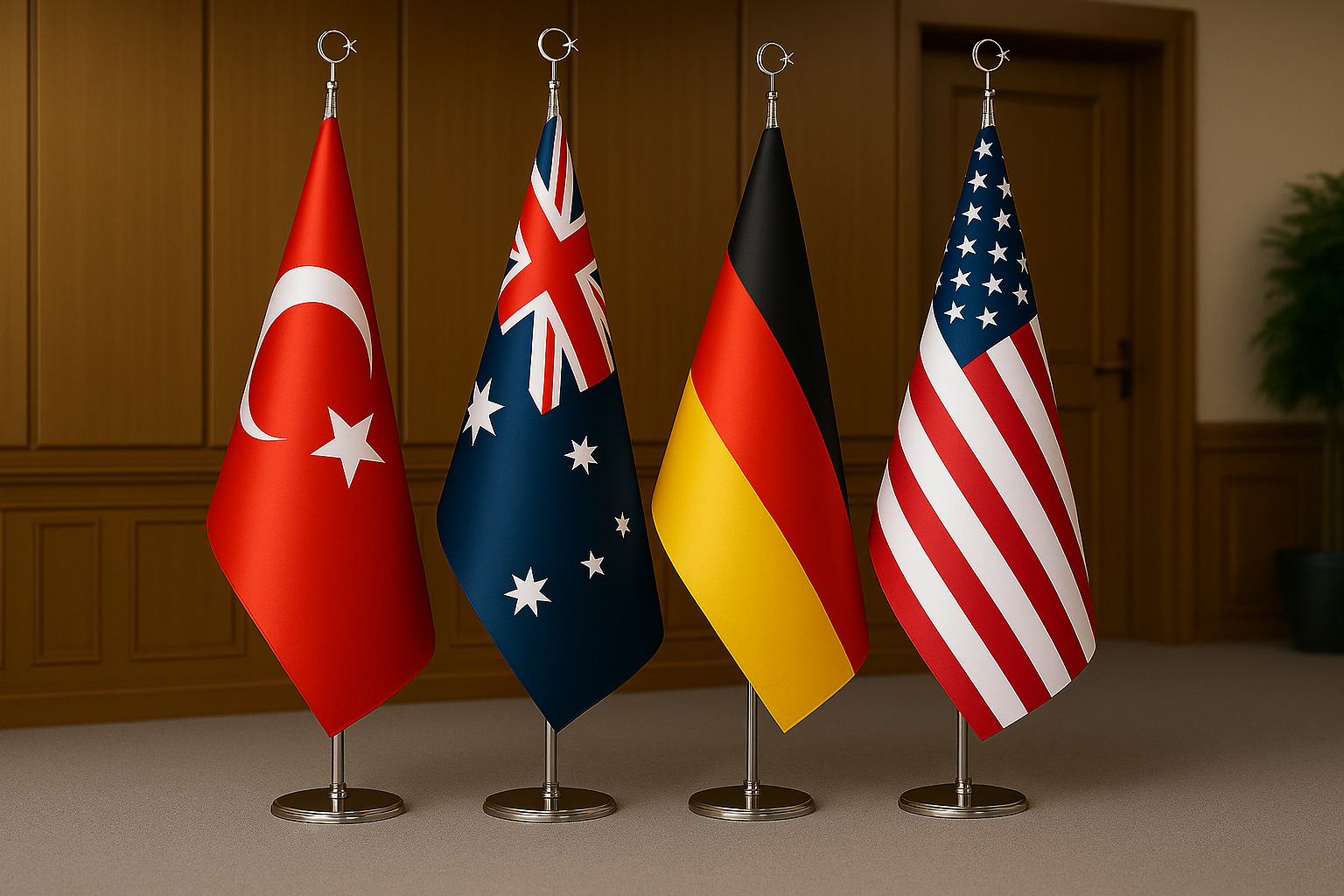
For outdoor display on a standard flagpole, both flags perform similarly because the stripe designs are bold enough to read clearly from a distance — but the choice is obvious: you fly the flag of the country you intend to represent. The Costa Rica Outdoor Flag and the Thailand Outdoor Flag are both made from 110g Raschel knitted polyester, a fabric weight that balances visibility with wind resistance in exposed outdoor locations. For ceremonial or diplomatic indoor settings, the coat of arms on the Costa Rica flag becomes essential — flying the plain-stripe civil version in an embassy context would be a protocol error — so the official indoor version with the printed emblem is the correct choice. For Thailand's indoor ceremonial use, the official indoor flag with its precisely rendered stripe proportions satisfies all diplomatic requirements without the complexity of a coat of arms. For educational displays, travel agencies, cultural festivals, or school geography projects, either flag works well at standard 3 ft × 5 ft (90 cm × 150 cm) or 4 ft × 6 ft (120 cm × 180 cm) sizes; for detailed guidance on sizing conventions specific to Costa Rica, the sibling article on Costa Rica flag sizes with and without the coat of arms covers every standard format in depth.
Lifespan and Long-Term Value for Each Flag
Both the Costa Rica and Thailand outdoor flags share identical construction — 110g Raschel knitted polyester with direct printing and heat-fixing — so their expected lifespan under comparable conditions is essentially the same: 6 months to 2 years for continuous outdoor exposure, depending on wind load, UV intensity, and rainfall. Raschel knitted polyester is 80% UV resistant, which means the vivid reds and blues in both flags retain their intensity significantly longer than budget alternatives. The indoor satin versions, used in controlled environments without UV stress, last considerably longer — often 3 to 5 years with normal handling — because satin at 100–165 g/m² is not subject to wind fatigue or solar degradation. From a total cost perspective, the two flags are priced equivalently, so the decision is never a financial one; it is entirely about which country's colors and history you are displaying. The only long-term cost difference arises if you are flying the Costa Rica flag with the coat of arms version, where the additional embroidery or printing complexity on a replacement flag may add a marginal cost compared to Thailand's emblem-free design.

Country Flags Collection
Browse outdoor and official indoor flags for Costa Rica, Thailand, and over 190 other nations — all available in UV-resistant Raschel polyester or premium satin for diplomatic use.
Browse Collection →What is the main difference between the Costa Rica flag and the Thailand flag? +
What are the official colors of the Costa Rica flag? +
Can you fly the Costa Rica flag without the coat of arms? +
Why do the Costa Rica and Thailand flags look so similar? +
How do I make sure I am displaying the Costa Rica flag the right way up? +
Which flag is better for outdoor use in windy or coastal environments? +
Are there other national flags that look like the Costa Rica or Thailand flag? +
Whether you need to display the Costa Rica flag with its distinctive coat of arms in a diplomatic setting or fly the Thailand flag's bold red-bordered triband outdoors, selecting the right format matters for both accuracy and longevity. The Costa Rica Outdoor Flag in 110g Raschel polyester and the Thailand Outdoor Flag in the same construction are both built for extended pole display, while the Costa Rica Official Indoor Flag and Thailand Official Indoor Flag on chrome metal poles deliver the precision required for embassies, government offices, and ceremonial venues. The full Country Flags collection covers both countries in every standard format. Bulk pricing is available for corporate orders, diplomatic procurement, and educational institutions needing multiple national flags for events or permanent display.


