





The Alaska flag arranges eight gold stars — seven forming the Big Dipper and one representing Polaris, the North Star — on a field of dark blue, with standard sizes ranging from 4 in × 6 in (10 cm × 15 cm) desk flags up to 5 ft × 8 ft (152 cm × 244 cm) display flags for government halls. Whether you're sourcing for a legislative chamber or a classroom, the State and City Indoor Flags collection covers the full range of official-grade options. Understanding both the star layout and the correct sizing is essential for anyone who wants to display Alaska's flag with accuracy and dignity — and this guide covers both in full detail.
How the Eight Stars Are Arranged on Alaska's Flag
The Alaska flag places seven gold stars in the shape of Ursa Major — the Great Bear, commonly called the Big Dipper — and one larger gold star in the upper-right canton area representing Polaris, the North Star. This layout was designed by 13-year-old Benny Benson in 1927 and adopted as the official territorial flag before Alaska achieved statehood in 1959. The blue field represents the sky, the sea, and the forget-me-not, Alaska's state flower. The North Star sits apart from the Dipper at the upper fly end and is intentionally larger than the seven Dipper stars, symbolizing Alaska's position as the northernmost state. Accurate reproduction of this constellation layout matters particularly on printed flags: any distortion in the angles between the seven Dipper stars or in the relative position of Polaris creates a flag that fails to meet the official design. Alaska state law and executive proclamations reference the original Benson design as the governing standard, meaning that printers using high-definition sublimation printing — rather than embroidery or simple screen printing — achieve the most faithful angular reproduction of the star positions.
Standard Alaska Flag Sizes and Where Each One Is Used
Alaska flags come in five commonly standardized sizes, each matched to a specific display context. Desk flags typically measure 4 in × 6 in (10 cm × 15 cm) and are used on office and conference tables. Parade and handheld flags run 8 in × 12 in (20 cm × 30 cm) or 12 in × 18 in (30 cm × 46 cm). Indoor pole flags for government buildings, courtrooms, and legislative chambers are most commonly 3 ft × 5 ft (91 cm × 152 cm) or 4 ft × 6 ft (122 cm × 183 cm). Outdoor and monumental sizes step up to 5 ft × 8 ft (152 cm × 244 cm) and 6 ft × 10 ft (183 cm × 305 cm) for flagpoles in front of state and federal facilities.
The 3 ft × 5 ft (91 cm × 152 cm) size is the most universal: it fits standard indoor floor-stand sets, works beside a U.S. flag in equal display, and reproduces the constellation clearly enough for a visitor at 10–15 ft (3–4.5 m) to read the Big Dipper without difficulty. The 4 ft × 6 ft (122 cm × 183 cm) size is preferred in governor's offices and larger public chambers where ceiling height allows an 8 ft (244 cm) pole. For ceremonial parades, the 12 in × 18 in (30 cm × 46 cm) format balances visibility with ease of handling. Knowing which size is expected before ordering prevents the most common display error: a flag that looks proportionally wrong against its surroundings or obscures the star detail because it is too small for the viewing distance.
 The desk-flag size — 4 in × 6 in (10 cm × 15 cm) — is the format most often requested for executive offices, school principals' desks, embassy tables, and conference rooms where space is limited but state identity still needs to be expressed clearly. Asya Bayrak's Alaska State Desk Flag features the dark blue and gold design with the Big Dipper faithfully reproduced, mounted on a chrome metal pole available in Silver Chrome or Gold finish to match office décor. At this small scale, print quality is everything: low-resolution designs cause the stars to bleed together, making it impossible to read the constellation accurately. High-definition sublimation printing resolves each of the eight stars as a distinct point, preserving the angular relationships Benny Benson originally defined. This makes the desk-flag format a surprisingly demanding print job — one where cut corners show immediately.
How to Choose the Right Size for Your Space, Pole, and Viewing Distance
The right Alaska flag size depends on three variables: the height of the space, the pole length you are using, and how far away most viewers will stand when looking at the flag. A flag that is too small for the pole droops and bunches; one that is too large crowds the room and obscures the star detail. As a general rule, viewers need a flag length of at least 1 in (2.5 cm) per 1 ft (30 cm) of viewing distance to resolve fine details like the star layout — meaning a flag displayed 15 ft (4.6 m) away should be at least 15 in (38 cm) on its long edge.
For a standard 8 ft (244 cm) indoor floor pole — the most common configuration in U.S. government and institutional settings — a 3 ft × 5 ft (91 cm × 152 cm) flag is ideal. The flag occupies roughly 60% of the pole height, which is the standard ratio recommended by flag protocol guidelines. For a 6 ft (183 cm) pole, a 2 ft × 3 ft (61 cm × 91 cm) flag maintains that proportion. Outdoor flagpoles scale differently: a 20 ft (6 m) pole typically flies a 4 ft × 6 ft (122 cm × 183 cm) flag, while a 25 ft (7.6 m) pole supports a 5 ft × 8 ft (152 cm × 244 cm) flag. For outdoor applications, also consider that Alaska's flag has subtle dark-on-dark star contrast under overcast skies; larger sizes improve legibility in natural light conditions. If you are pairing the Alaska flag with the U.S. flag — as protocol requires in most public displays — both flags should be the same size so neither dominates the other.
The Ratio Between Pole Height and Flag Size That Protocol Expects
The standard ratio used by U.S. flag protocol and most institutional display guidelines is that the fly length (horizontal width) of the flag should equal approximately 25–33% of the pole's total height. This ratio keeps the flag visible without overwhelming the pole or making the display look disproportionate. For a 9 ft (274 cm) ceremonial indoor pole, that calculation produces a fly length of roughly 27–36 in (69–91 cm), pointing squarely to the 3 ft × 5 ft (91 cm × 152 cm) flag as the correct match.
Alaska's flag has an official aspect ratio of 125:177 — slightly wider than the 2:3 ratio used by most U.S. state flags. This means that if you are producing custom Alaska flags to strict official specifications, the proportions are not exactly 2:3. Most commercially available flags use the standard 2:3 ratio as a practical approximation, and this is acceptable for most display purposes. Institutions requiring strict conformity to the official Alaska state flag statute should specify the 125:177 ratio when ordering. The difference is subtle — about 1.5% in the hoist dimension — but it affects how the stars sit relative to the borders when the flag is displayed flat on a wall rather than hanging from a pole. If you want to understand how similar sizing and proportion decisions affect other state flags, the guide on Maryland flag sizes and which way is up covers analogous considerations for another complex state flag design.
How Indoor, Outdoor, and Desk Sizes Compare Side by Side
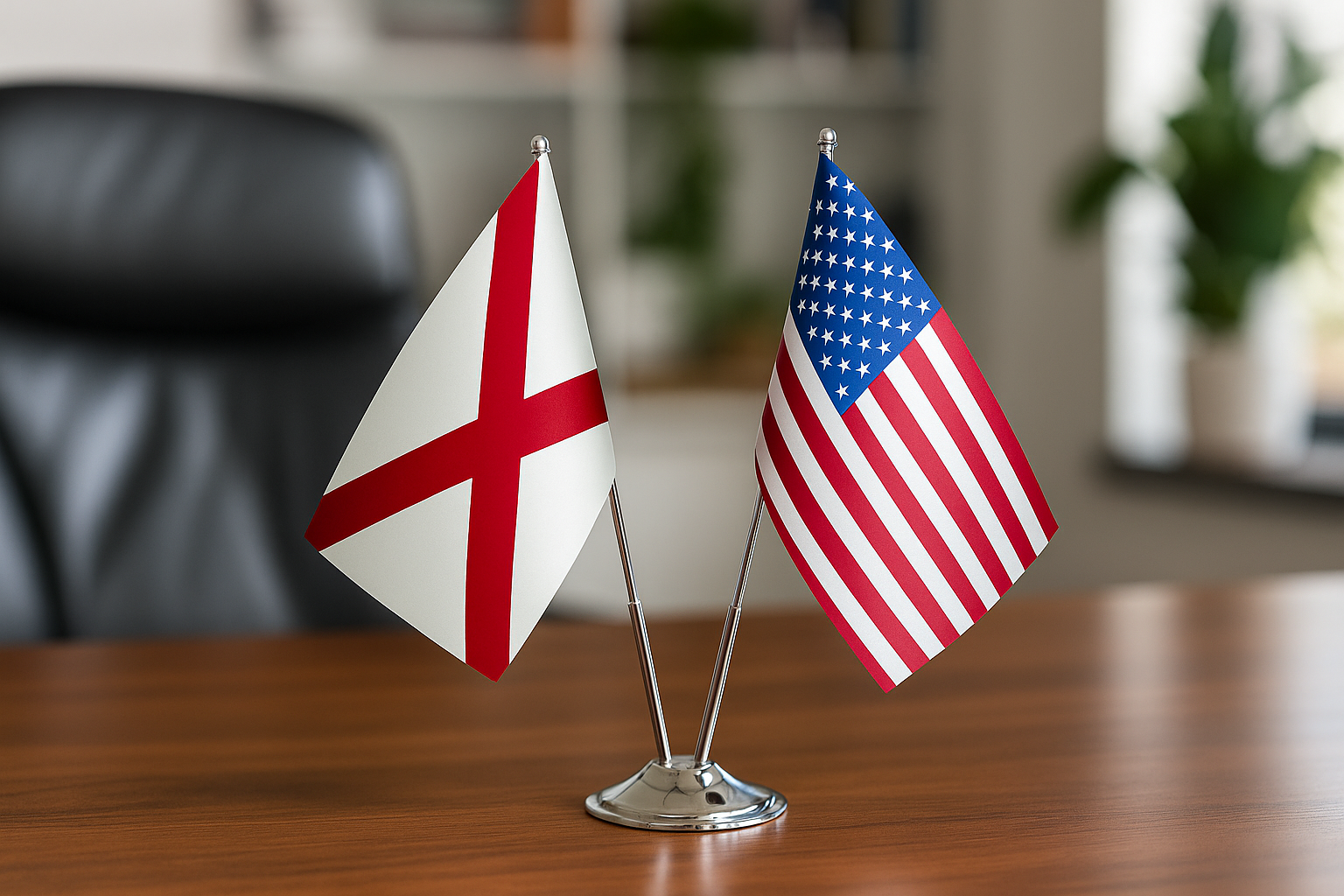
 Indoor, outdoor, and desk flags serve different purposes and use different materials, but the core sizing logic follows the same principle: match the flag's dimensions to the display context and viewing distance. Desk flags (4 in × 6 in / 10 cm × 15 cm) are close-range display items — seen from 2–4 ft (60–120 cm) — and prioritize print sharpness over size. Indoor pole flags (3 ft × 5 ft to 4 ft × 6 ft / 91–183 cm) are mid-range displays in enclosed spaces where wind is not a factor, so fabric weight and drape matter more than outdoor durability. Outdoor flags (4 ft × 6 ft to 6 ft × 10 ft / 122–305 cm) face UV exposure, wind loading, and rain, requiring heavier weave construction and reinforced headers. For anyone displaying Alaska alongside U.S. colors in a professional setting, Asya Bayrak's Alaska & U.S. Desk Flag Set provides a matched pair in the same size on coordinating chrome poles — available in Silver Chrome or Gold finish — so both flags maintain equal visual weight, which is what flag protocol requires when two flags share a display.
A side-by-side comparison makes the scale differences concrete. A desk flag at 4 in × 6 in (10 cm × 15 cm) has a surface area of 24 sq in (155 sq cm). A 3 ft × 5 ft (91 cm × 152 cm) indoor flag has a surface area of 15 sq ft (1.4 sq m) — about 90 times larger. A 5 ft × 8 ft (152 cm × 244 cm) outdoor flag reaches 40 sq ft (3.7 sq m). Each jump in size is not just cosmetic: it changes the fabric weight needed to drape properly, the printing method required to keep colors saturated at full scale, and the mounting hardware necessary to support the flag safely. These practical differences are why a flag intended for one context should not simply be scaled up or down for another — the results look wrong and often perform poorly.
Sizing Mistakes That Make Alaska's Star Layout Look Wrong
The most damaging sizing mistake is choosing a flag that is too small for the pole and display distance, which collapses the star detail into an unreadable cluster. At viewing distances beyond 20 ft (6 m), a 2 ft × 3 ft (61 cm × 91 cm) flag — which is more appropriate for a 6 ft / 183 cm pole — cannot render all eight stars as distinct points; the Big Dipper merges into the background blue field. The second most common mistake is mismatching the Alaska flag size with the U.S. flag it accompanies. Under U.S. Flag Code (4 USC §§ 1–10) guidelines for display alongside other flags, both flags should be the same size and at the same height; a noticeably smaller state flag implies subordination that is not required by protocol.
A third mistake is applying outdoor flag dimensions to an indoor setting. A 5 ft × 8 ft (152 cm × 244 cm) outdoor flag hung in a standard 10 ft (305 cm) ceiling room overwhelms the space, puddles on the floor if hung from a pole, and in still indoor air will never unfurl to show the star layout clearly. The reverse error — using an indoor satin flag outdoors — causes rapid fading and fabric failure within weeks rather than the 6 months to 2 years lifespan a properly specified outdoor flag delivers. Finally, ordering non-standard aspect ratios from discount suppliers often results in stars that are placed incorrectly relative to the flag borders, because the star positioning percentages are calibrated to official proportions. Always verify that your supplier is reproducing the star positions from the official Alaska state flag specification, not from an approximated template. For a parallel look at how sizing and orientation errors affect another distinctive flag, the article on how to fly the swallowtail Ohio flag correctly is a useful companion read.

State and City Indoor Flags
Official-grade indoor flags for all 50 states and major cities, built for government offices, courthouses, and institutions that require accurate, dignified display.
Browse Collection →How many stars are on the Alaska flag and what do they represent? +
What is the standard size of the Alaska state flag for indoor display? +
What is the official aspect ratio of the Alaska flag? +
Can I use the same Alaska flag indoors and outdoors? +
Does the Alaska flag need to be the same size as the U.S. flag when displayed together? +
What flag size works best on a 20 ft outdoor flagpole for Alaska's flag? +
Why do some Alaska flags look like they have the stars in wrong positions? +
Choosing the right Alaska flag begins with knowing your pole height, your room dimensions, and your viewing distance — then matching those to the size tier that makes the eight-star constellation legible and proportionally correct. For official institutional use, the Alaska Official Indoor Flag delivers the dark blue field and gold star layout via high-definition sublimation printing on double-layer satin fabric with a durable chrome metal pole, built for state legislature halls, governor offices, courthouses, and public institutions. If you need a desk-level display, the Alaska State Desk Flag and the Alaska & U.S. Desk Flag Set offer professionally finished chrome-pole options in Silver Chrome or Gold finish for executives and educators alike. Browse the full USA State Desk Flags collection for coordinated state display options. Bulk pricing is available for corporate, government, and institutional orders — contact Asya Bayrak directly for volume quotes.


