







For most indoor settings, flag pole heights range from 7 ft (2.1 m) for standard office ceilings up to 9–10 ft (2.7–3.0 m) for high-ceiling lobbies and ceremonial halls — and choosing the wrong height throws the entire presentation off. Whether you are outfitting a government office, embassy, school, or corporate boardroom, selecting the correct indoor flag pole height is the single most impactful decision you will make. Browse the full Indoor Flags collection to see poles, flags, and complete sets built for every ceiling height.
Standard Indoor Flag Pole Heights and Where Each One Is Used
The three most common indoor flag pole heights are 7 ft (2.1 m), 8 ft (2.4 m), and 9 ft (2.7 m), each suited to a specific ceiling range. A 7 ft pole works in rooms with 8–9 ft (2.4–2.7 m) ceilings — the everyday height found in offices, classrooms, and small conference rooms. An 8 ft pole fits well in spaces with 9–10 ft (2.7–3.0 m) ceilings such as courtrooms, municipal offices, and mid-size corporate lobbies. A 9 ft or 10 ft pole belongs in ceremonial halls, embassy reception rooms, state legislature chambers, or any room where the ceiling clears 11 ft (3.3 m) or more. Going taller than those guidelines crowds the finial against the ceiling and blocks the eagle or spear ornament — a mistake that reads as careless in any formal setting.
- 7 ft (2.1 m): Classrooms, small offices, retail stores — ceiling height 8–9 ft
- 8 ft (2.4 m): Courtrooms, corporate boardrooms, municipal offices — ceiling height 9–10 ft
- 9 ft (2.7 m): Embassy lobbies, ceremonial halls, legislative chambers — ceiling height 10–12 ft
- 10 ft (3.0 m): Grand reception rooms, high-ceiling auditoriums — ceiling height 12 ft+
How to Choose the Right Height for Your Space
The simplest rule is this: leave at least 12 in (30 cm) of clearance between the top of the finial and the ceiling so the ornament reads clearly and the flag can hang without bunching. Start by measuring the finished ceiling height, then subtract 12 in for clearance and another 6–9 in (15–23 cm) for the finial itself — the result gives you the maximum practical pole length. Viewing distance also matters: a flag on a 7 ft pole looks correct from across a 15 ft (4.5 m) room but can feel small and lost in a 40 ft (12 m) lobby where a 9–10 ft pole and a proportionally larger flag are needed. If the room has coffered or vaulted ceilings, measure to the lowest structural point directly above the flag base, not to the peak, so the assembly never feels cramped at one angle and oversized at another. For formal institutional environments, US protocol references (4 USC §§ 1–10) do not specify pole height but do require that the flag be displayed with dignity — which in practice means it should hang freely without touching the floor, furniture, or ceiling.
 One element that is often overlooked when selecting a pole height is the base itself, because the base contributes 2–4 in (5–10 cm) of additional lift that affects how close the finial comes to the ceiling. The Iron Base is a free-standing iron base measuring 40×40 cm (16×16 in) — its own weight holds the pole upright without drilling, making it suitable for embassies, showrooms, event areas, and any setting where permanent installation is not possible. Because it sits flat on the floor, the base height is negligible, but you should still include it in your total clearance calculation when ceiling space is tight. A stable, well-proportioned base also prevents the pole from leaning — even a 1–2 degree lean at 9 ft (2.7 m) of height translates to several inches of lateral drift at the finial, which looks unprofessional in a formal presentation environment. Pair a correctly sized base with the right pole length and the entire assembly will stand plumb and imposing from any angle in the room.
What the Right Pole-to-Flag Ratio Looks Like in Practice
The standard ratio for indoor flags is that the flag's fly length (horizontal width) should equal approximately 25–33% of the pole height — meaning a 7 ft (2.1 m) pole pairs with a 3×5 ft (0.9×1.5 m) flag, and a 9 ft (2.7 m) pole pairs with a 4×6 ft (1.2×1.8 m) flag. A flag that is too small hangs limply in the lower third of the pole and looks like an afterthought; a flag that is too large drags toward the floor and risks touching it — which violates US Flag Code protocol. The standard indoor flag sizes track neatly with pole heights: 3×5 ft flags are the default for 7–8 ft poles, while 4×6 ft flags are the correct choice for 9–10 ft poles in ceremonial settings. FIAV (Fédération internationale des associations vexillologiques) standards similarly recommend that indoor display flags be printed to the exact proportional ratio of the national flag — 10:19 for the US flag — to preserve the correct visual geometry when hung indoors.
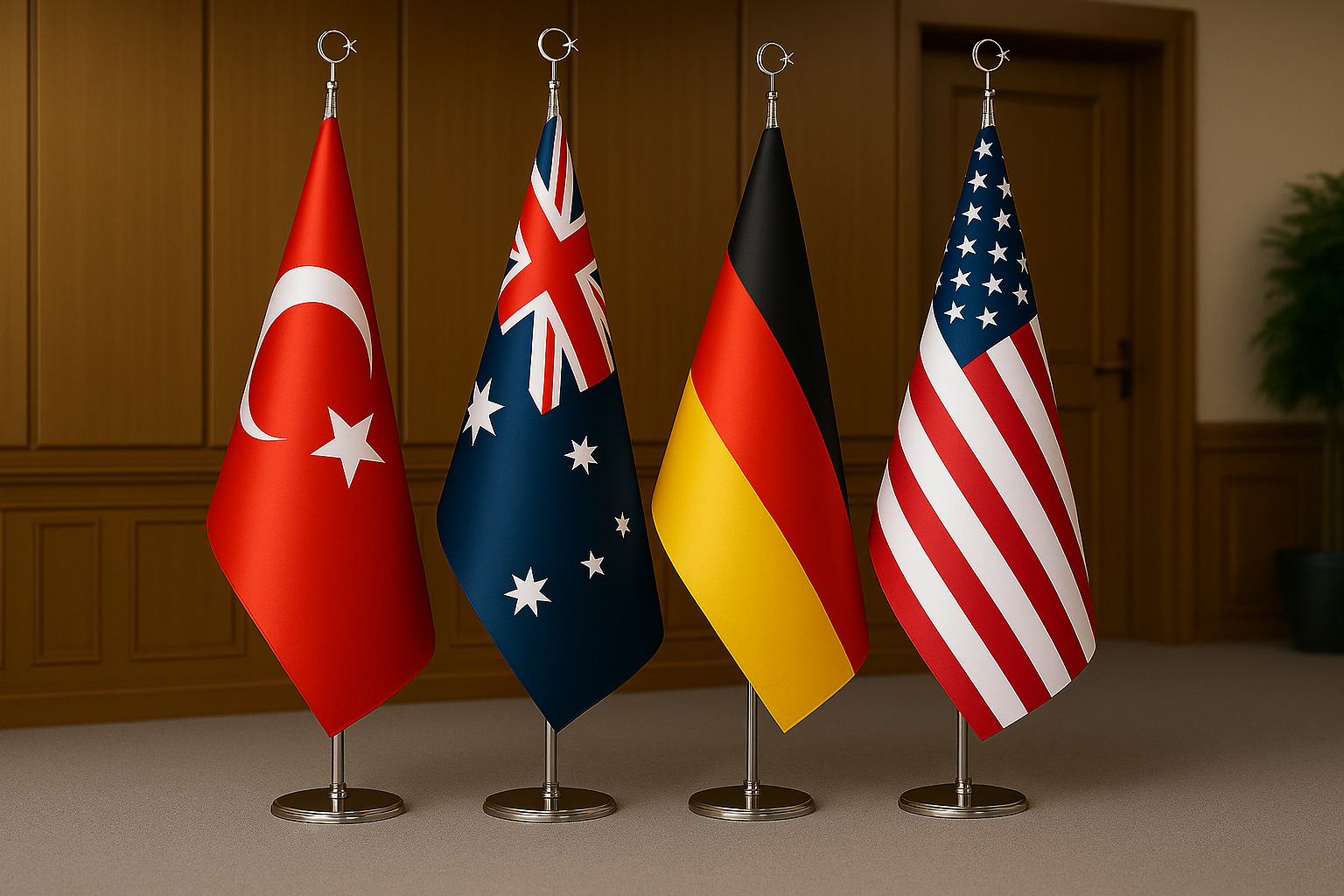
 The USA Official Indoor Flag is built with exactly this ratio in mind — the double-layer satin fabric on a durable chrome metal pole is designed to hang with the correct drape for institutional settings, whether it is flanking a speaker's podium, standing beside the President's desk, or displayed in an embassy reception room. High-definition sublimation printing faithfully reproduces all 50 stars and the precise red, white, and blue stripe proportions, so the flag looks authoritative at close inspection distances common in indoor settings. When placing the flag in a room, position the pole so the flag's heading (the sleeve side) is to viewer's left — this follows the protocol that the US flag's own right side (the canton with stars) faces the observer's left when displayed indoors. For diplomatic venues that display multiple national flags side by side, all poles should be the same height and all flags the same size so no single nation's flag appears subordinate. The Country Indoor Flags collection offers official sets for a wide range of nations in matching sizes, making multi-flag protocol arrangements straightforward.
How Indoor, Outdoor, and Desk Flag Sizes Compare
Indoor flag poles, outdoor poles, and desk flags each occupy a distinct size tier, and they are not interchangeable. Indoor poles run 7–10 ft (2.1–3.0 m) and carry flags of 3×5 ft or 4×6 ft (0.9×1.5 m or 1.2×1.8 m). Outdoor flagpoles for a typical commercial building start at 20–25 ft (6.1–7.6 m) and carry flags of 4×6 ft or 5×8 ft (1.2×1.8 m or 1.5×2.4 m). Desk flags are tabletop-scale, typically 4×6 in or 6×9 in (10×15 cm or 15×23 cm) on a 10–12 in (25–30 cm) stick. The construction materials also differ: outdoor poles must resist UV, rain, and wind — outdoor flags are typically rated for 6 months to 2 years of continuous exposure — while indoor satin flags are engineered for appearance rather than weather durability. If you are curious how sizing principles translate to outdoor installations, our article on in-ground vs. wall-mounted flagpoles for a home covers outdoor pole selection in detail.

Indoor Flags Collection
Complete indoor flag sets — poles, bases, flags, and finials — matched for every ceiling height from 8 ft offices to 12 ft ceremonial halls.
Browse Collection →Sizing Mistakes That Make an Indoor Flag Display Look Wrong
The most common indoor flag sizing mistake is using a pole that is too tall for the ceiling — the finial gets hidden behind a ceiling tile or beam, the flag bunches at the top, and the entire assembly looks improvised. A close second is pairing an 8 ft (2.4 m) pole with a 3×5 ft (0.9×1.5 m) flag in a high-ceiling room: the flag occupies only the bottom third of the pole and looks like it belongs in a different, smaller room. A third frequent error is ignoring the floor-to-bottom-hem clearance — US Flag Code (4 USC § 8) is explicit that the flag must never touch the floor, furniture, or ground; if the flag's hem comes within 4–6 in (10–15 cm) of the floor, the pole is too tall or the flag is too long for that pole height. Fringed flags, which are traditional for indoor ceremonial use, add about 2–3 in (5–8 cm) of fringe below the hem — factor that into your clearance check. For a deeper look at fringed vs. plain flag decisions for ceremonies, see our article on fringed vs. plain flags for indoor ceremonies.
Another underappreciated mistake is placing the flag too close to a wall. Indoor poles should stand at least 6 in (15 cm) away from the nearest wall so the flag can hang freely without catching on the baseboard or trim when air conditioning or foot traffic creates air movement. Finally, pairing mismatched pole heights in a multi-flag arrangement — say, a 9 ft pole for the national flag and a 7 ft pole for the state flag — violates both visual balance and protocol. All poles in a ceremonial grouping should be identical in height and finish. The Canada Official Indoor Flag, for example, is built on a chrome metal pole that can be matched in height and finish to a US flag pole for side-by-side diplomatic display without any visual inconsistency.
FAQ
What height indoor flag pole works best for a standard 9 ft ceiling? +
Do I need a special stand for an indoor flag pole if I cannot drill into the floor? +
What flag size pairs with a 9 ft indoor pole? +
Can I use an outdoor flag on an indoor pole? +
How many indoor flag poles can I fit side by side without the flags touching each other? +
Does the US Flag Code specify an indoor flag pole height? +
What is the purpose of a finial on an indoor flag pole and does it affect the height I choose? +
Getting your indoor flag pole height right is a matter of measuring carefully, respecting the pole-to-flag ratio, and understanding the clearance rules that keep the display looking authoritative rather than improvised. For government offices and diplomatic missions, the USA Official Indoor Flag on a chrome metal pole delivers the institutional presence those settings demand, while the Canada Official Indoor Flag provides a matching set for bilateral or multi-flag diplomatic arrangements. If you need a stable, drill-free solution to anchor any pole on any floor surface, the Iron Base provides the weight and footprint to keep tall poles upright and plumb. Explore the complete Indoor Flags collection to find poles, flags, and bases already matched for specific ceiling heights — bulk pricing is available for corporate, embassy, and institutional orders.


