







Bunting flag rules for streets and venues fall into two practical categories: compliance requirements set by local authorities and best-practice guidelines that keep displays safe and looking professional. Whether you are decorating a Main Street corridor for a civic celebration or dressing a stadium concourse for a sporting event, understanding both sets of rules before you hang a single strand will save you time, fines, and embarrassment. Our String Pennants collection is designed with these real-world installation requirements in mind, offering 164 ft (50 m) runs of digitally printed bunting built for sustained outdoor use.
What US Law and Local Codes Actually Say About Street Bunting
The US Flag Code (4 USC §§ 1–10) governs display of the national flag itself but does not directly regulate decorative bunting or pennant strings — those fall under municipal codes, event permits, and right-of-way ordinances. This distinction matters enormously: patriotic bunting displaying red, white, and blue stripes is specifically permitted as a decorative element under Flag Code guidance (4 USC § 8(i)), provided it is never used as, or confused with, an actual American flag. That means bunting should not have 50 stars and 13 stripes arranged identically to the national ensign, and it must not be draped over a flagpole in a way that displaces a properly flown flag. Beyond federal guidance, most US cities require a street-use permit or right-of-way encroachment permit any time decorations cross or overhang a public sidewalk or roadway. Permit requirements vary widely — New York City's Department of Transportation, for example, sets minimum overhead clearance of 10 ft (3.05 m) above sidewalks — so always contact your city's public works or transportation department at least four to six weeks before your event date.
How High Must Bunting Hang Over Roads and Walkways
The minimum clearance standard most US jurisdictions adopt is 14 ft 6 in (4.42 m) above the roadway for vehicular traffic and 8 ft (2.44 m) above pedestrian walkways, though many cities set higher thresholds. These numbers come from the Manual on Uniform Traffic Control Devices (MUTCD) and local fire codes, not from flag law, which is why checking with your city's engineering department is non-negotiable before a street installation. For outdoor festivals and venue forecourts where no vehicles pass beneath the bunting, an 8 ft (2.44 m) clearance is typically the minimum enforced by fire marshals to ensure emergency egress is not obstructed. When in doubt, err on the side of more height — a strand that is too high is invisible to code inspectors; a strand that clips a truck mirror is a liability event. Attachment points also matter: bunting must be secured to fixed structures (lamp posts, building facades, temporary scaffold) with hardware rated for the weight and wind load, never simply knotted around a street sign or parking meter. For detailed guidance on safe attachment methods, our related article on where pennant strings can be hung safely covers anchor-point selection in depth.
 Proper height compliance becomes straightforward when you choose bunting engineered for outdoor use from the outset. The USA Rectangular Flag Bunting runs 164 ft (50 m) per strand, giving event organizers enough continuous length to span most standard city blocks or venue entrances without mid-run splices that create weak points. Each flag panel is digitally printed on 90 g/m² Raschel knitted polyester — a breathable, UV-resistant fabric that allows wind to pass through rather than loading against anchor points, which is exactly why outdoor engineers prefer open-weave materials for elevated installations. The heat-cut edges resist fraying over a full season, so the display remains clean and professional through repeated wind cycles rather than developing the tattered look that prompts code complaints. For American-themed events from Independence Day to Veterans Day, this is a code-compliant, installer-friendly choice.
What Is Prohibited When Displaying Bunting on Public Streets
Several clear prohibitions apply regardless of jurisdiction. First, bunting must never obstruct traffic signals, street signs, fire hydrants, or emergency access points — this is both a fire code and traffic code violation in every US state. Second, bunting that incorporates the actual design of the US national flag (stars and stripes in precise proportion) is subject to Flag Code restrictions: it may not touch the ground, be used as apparel, or be displayed in a deteriorated condition (4 USC § 8). Third, electrical lighting integrated into bunting strands must meet NEC (National Electrical Code) Article 590 requirements for temporary wiring, including GFCI protection in outdoor and wet locations. Fourth, any bunting over a public right-of-way without a valid permit is subject to immediate removal by municipal crews, often at the organizer's expense. Private venue property is generally exempt from right-of-way rules, but fire code clearance and structural load requirements still apply inside arenas, shopping centers, and parking structures. Finally, in many historic districts, outdoor decorations require approval from a historic preservation commission — always check your venue's zoning classification before ordering.
Half-Staff and Ceremonial Considerations for Patriotic Bunting
Decorative bunting is not subject to half-staff orders in the way a formal flag is, but ceremonial context still demands sensitivity. When a presidential proclamation or gubernatorial order mandates half-staff, event organizers should consider whether a festive bunting display is appropriate at all — particularly for government buildings and civic spaces. The Flag Code's intent (4 USC § 7) is that the national flag takes visual precedence over all other displays; if your bunting competes visually with a flag flown at half-staff, best practice is to remove or reduce the bunting for the duration of the mourning period. For strictly decorative, non-patriotic bunting — think seasonal colors, sports team colors, or holiday themes — no half-staff restriction applies. Internationally, FIAV (Fédération Internationale des Associations Vexillologiques) standards distinguish between national flags and decorative textile elements; bunting falls firmly in the decorative category under those standards, freeing event planners from vexillological protocol as long as no sovereign flag design is reproduced.
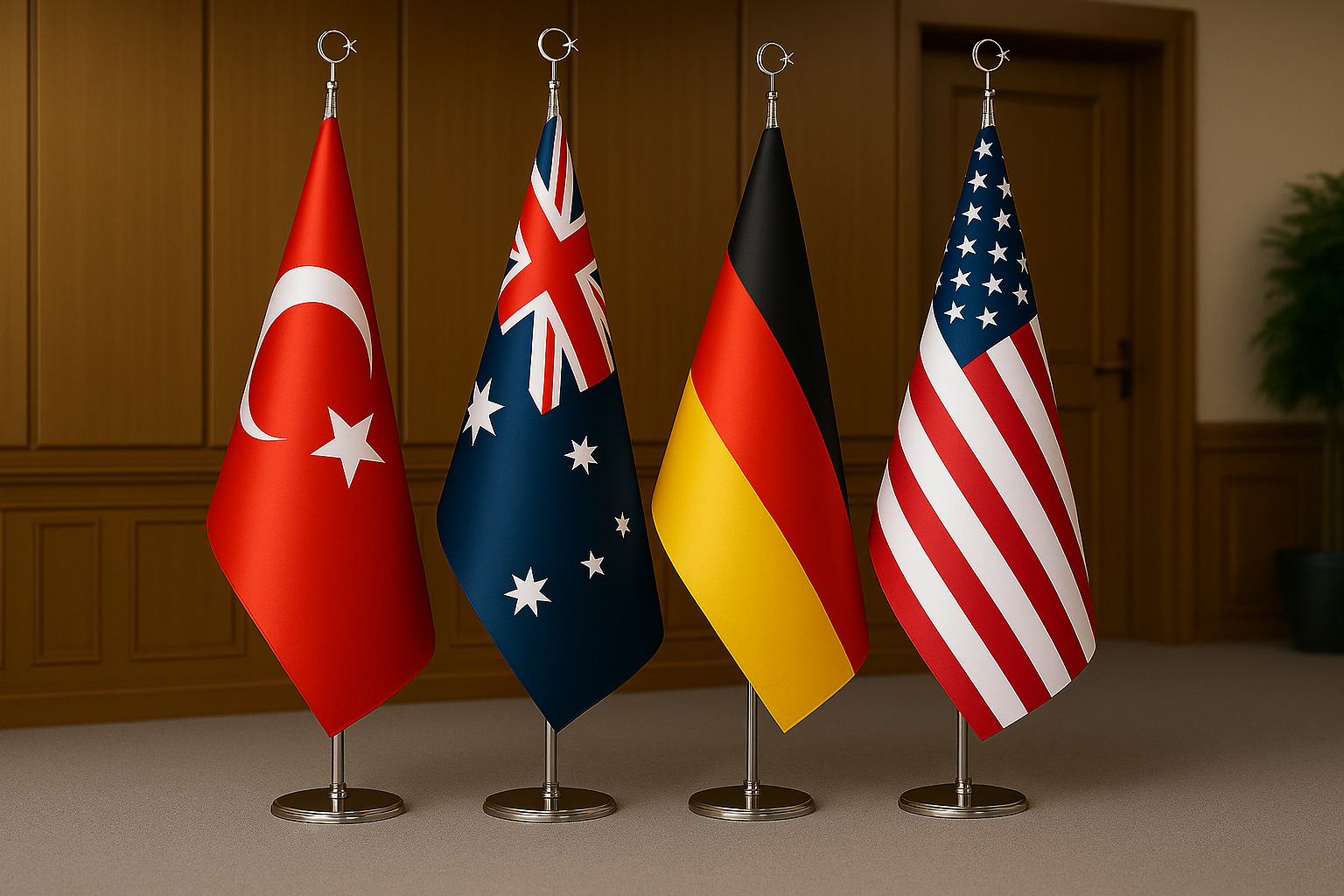
 For national holiday displays that involve recognized symbolic designs, the distinction between a decorative motif and a protected national flag becomes especially important. The 3 Hilal Rectangular Flag Bunting — also available as 164 ft (50 m) strands printed on 90 g/m² Raschel fabric — illustrates how a culturally specific motif can be incorporated into event bunting while remaining clearly decorative rather than a sovereign flag display. Event organizers working with consulates, cultural associations, or international sports delegations often need exactly this type of product: visually rich, nationally referential, but not subject to diplomatic flag protocol. The breathable Raschel fabric keeps wind loads manageable across long spans, and the rectangular panel format gives maximum graphic area for vibrant design reproduction. When planning international or multicultural events, this kind of custom-motif bunting bridges celebration and compliance neatly.
A Practical Compliance Checklist for Institutions and Event Planners
A systematic pre-installation checklist eliminates the most common compliance failures before they become problems on event day. Use the following framework as a minimum standard for any public street or venue installation.
- Permit obtained: Confirm right-of-way or special event permit is in hand at least two weeks before installation date.
- Clearance verified: Measure actual overhead clearance at the lowest point of the installed span — 14 ft 6 in (4.42 m) minimum for vehicle traffic; 8 ft (2.44 m) for pedestrian-only zones.
- Anchor points inspected: Confirm all attachment structures are rated for the combined weight and wind load. A 164 ft (50 m) strand of 90 g/m² Raschel bunting is lightweight, but dynamic wind load can multiply effective force by 3–5×.
- Fire code clearance: Verify no bunting hangs within 3 ft (0.91 m) of any lighting fixture, heat source, or electrical panel.
- Signal and signage obstruction check: Walk the installation route and confirm no traffic signals, stop signs, or wayfinding signs are obscured.
- Flag Code review: If bunting incorporates national colors or symbols, confirm no design element could be mistaken for the actual national flag.
- Half-staff awareness: Check for active half-staff proclamations (visit whitehouse.gov or your state governor's website) before installing patriotic displays.
- Takedown plan confirmed: Know your removal deadline — most street permits specify a removal window, and overstaying it results in fines.
- Condition inspection on retrieval: Inspect bunting for UV fade, fraying, or structural damage before storing for reuse. For best-practice storage guidance, see our article on how to store bunting between seasons.

String Pennants Collection
A complete range of outdoor-rated pennant strings and flag bunting built for street-level and venue installations — ready for permits, clearance requirements, and all-weather use.
Browse Collection →Order of Precedence When Multiple Flags and Bunting Share a Venue
When decorative bunting is displayed alongside formal flags at the same venue, the order of precedence established under 4 USC § 7 must be respected for any national flags present. The US flag always occupies the position of honor — marching right, or the observer's left when flags are displayed against a wall — and no decorative bunting strand should visually compete with or physically touch a formally displayed national flag. In multi-nation events governed by FIAV protocol, national flags are displayed in alphabetical order by the host nation's official language, and bunting used as venue decoration must be positioned so that it frames rather than obscures any national ensign. For sports venues hosting international competition, the IOC and FIFA each publish specific flag display guidelines that supersede local decoration preferences; event managers should obtain these from the governing body's official documentation. Practically, this means bunting is typically hung at eave or truss level, while formal flags occupy dedicated poles or wall-mounted staffs at a lower, more visually prominent position. This hierarchy — formal flag at eye level, decorative bunting as a canopy overhead — satisfies both protocol and aesthetics simultaneously. For further reading on street-level display formats, our article on pole banner sizes for streets and campuses covers the complementary use of vertical pole banners alongside horizontal bunting runs.
Do I need a permit to hang bunting across a public street? +
What is the minimum height for bunting over a road? +
Does the US Flag Code restrict decorative bunting at all? +
Can I use Welsh Nadolig Llawen (Merry Christmas) bunting on a public street in the US? +
Should bunting be removed during a half-staff order? +
How long does outdoor bunting typically last before it needs replacing? +
Is triangular or rectangular bunting better for street displays? +
Getting bunting right for streets and venues means combining compliance knowledge with smart product choices. For your next event, explore the full range in the String Pennants collection and the Country Bunting Flags collection — both include rectangular and triangular formats in 164 ft (50 m) runs on durable 90 g/m² Raschel fabric, purpose-built for outdoor installation. If you need to calculate how many strands your venue requires before ordering, our guide on how much bunting you need walks through the measurement formula step by step. Bulk pricing is available for corporate orders, municipal events, and recurring festival organizers — contact us directly for a volume quote tailored to your installation requirements.


