

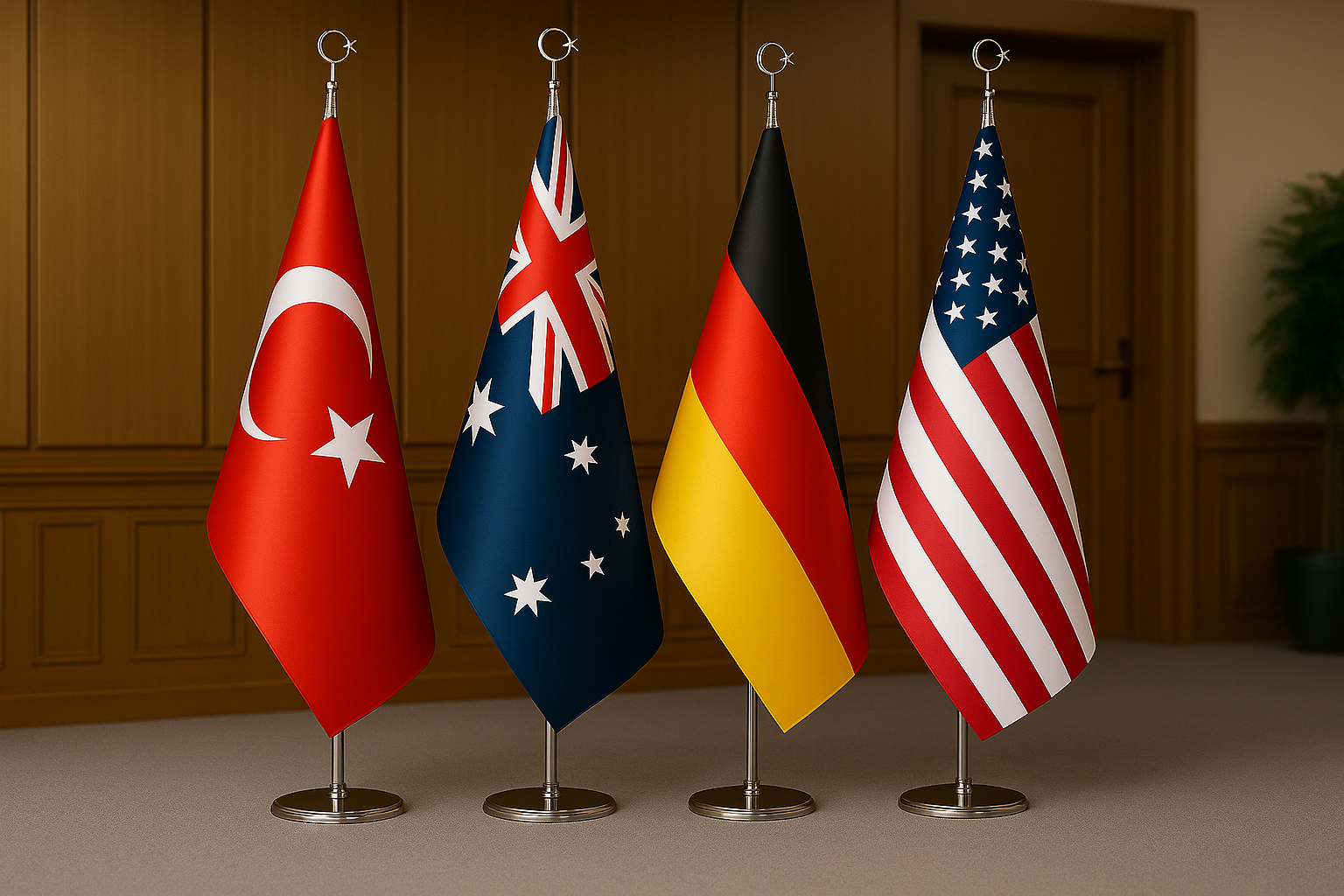





When displaying a flag vertically — against a wall, in a window, or suspended over a street — specific orientation rules must be followed to honor the flag's symbolism and comply with applicable law. For the American flag, the U.S. Flag Code (4 USC §§ 1–10) provides clear guidance on vertical display, while other national flags follow their own sovereign protocols and FIAV standards. Whether you need a single ceremonial piece or a full institutional installation, the Vertical Country Flag collection offers purpose-built options designed for correct vertical presentation across dozens of nations.
The Legal Basis: U.S. Flag Code and International Framework
The U.S. Flag Code (4 USC §§ 1–10), enacted in 1942, is the statutory foundation governing how the American flag must be displayed in every orientation, including vertical. Although the Code carries no criminal penalties for civilians, it represents binding guidance for federal agencies and establishes the authoritative standard for respectful display nationwide. Section 7(i) specifically addresses vertical and horizontal display against a wall, stipulating that the union (the blue field of stars) must appear uppermost and to the flag's own right — which is the observer's left. This is the most commonly misunderstood rule in vertical flag display, and getting it wrong is immediately visible to anyone familiar with the Code.
For international flags, the situation varies by country. Many nations codify their flag laws through dedicated acts — India's Flag Code of India, 2002 is one of the most detailed — while others rely on executive protocol or FIAV (Fédération Internationale des Associations Vexillologiques) standards to guide correct orientation during vertical display. Understanding which legal framework applies to a given flag is the starting point for any responsible display decision. Institutions displaying multiple national flags should always verify the sovereign rules for each flag individually, not assume that U.S. Flag Code logic universally applies.
Correct Orientation and Order of Precedence for Vertical Display
For the American flag displayed vertically, the union must appear in the upper-left corner from the observer's perspective — the flag's own right — with no exceptions. This rule applies whether the flag is hung flat against a wall, suspended from a rope across a street, or mounted in a stairwell window. The stripes run top-to-bottom rather than left-to-right, but the canton's position remains consistent: upper-left as seen by the viewer, always.
 Flags that use horizontal tricolor designs — like the Hungary Vertical Flag — present a specific challenge: Hungary's civil flag runs red-white-green from top to bottom horizontally, but when hung vertically the stripes must run left to right as originally designed, which requires a flag that is purpose-manufactured for vertical suspension rather than simply rotated. Hungary's national law specifies this orientation explicitly, and flags intended for vertical display in Hungarian institutional settings are woven or printed with the stripe orientation already adjusted for the vertical pole. This is exactly why ordering a dedicated vertical-format flag rather than adapting a standard horizontal flag matters for compliance. Purpose-built vertical flags typically include reinforced heading tape along the appropriate edge and grommets positioned for correct top-mounting, saving institutions from improvised and non-compliant solutions. If your institution displays multiple European national flags, always source vertical-format versions manufactured to each country's sovereign specification.
Order of precedence for multi-flag vertical displays follows the same hierarchy as horizontal arrangements. Under U.S. Flag Code Section 7, the American flag always occupies the position of honor — the observer's far left in a row, or the center-and-highest position when grouped. State flags follow, then military service flags in order of establishment (Army, Marine Corps, Navy, Air Force, Space Force, Coast Guard during wartime), then other organizational or foreign flags. Foreign flags displayed alongside the American flag should be flown at equal height and in alphabetical order by nation name in English, consistent with United Nations protocol.
What Is Prohibited in Vertical Flag Display
U.S. Flag Code Section 8 lists explicit prohibitions that apply regardless of display orientation, including vertical arrangements. The flag must never be displayed with the union down except as a signal of dire distress; this rule is particularly relevant for vertical displays because an upside-down vertical flag — with stripes at top and union at bottom-right — is a recognized distress signal and must not be used decoratively. Beyond orientation, the Code prohibits using the flag as drapery, bedding, or covering for a ceiling. Vertical wall-hung flags must be mounted as flags, not draped or folded decoratively.
 The prohibition against allowing the flag to touch the ground or floor (Section 8(b)) is especially important in vertical window or doorway installations, where the lower edge of the flag may hang near the ground depending on ceiling height and flag size. A standard 3 ft × 5 ft (91 cm × 152 cm) flag hung vertically in a standard 8 ft (244 cm) ceiling space has approximately 3 ft of clearance when mounted at the top — barely enough if the flag is not hemmed or if the pole bracket is positioned low. Institutions should calculate clearance precisely before selecting flag dimensions. The Outdoor Vertical Abhazya Flag demonstrates how purpose-built vertical flags are manufactured with the correct heading placement and proportions so that standard mounting hardware keeps the lower edge well clear of surfaces. Flags must also never bear any mark, insignia, letter, word, figure, design, picture, or drawing of any nature when used as a flag per Section 8(g) — so institutional custom printing on a flag's field is prohibited for U.S. flags but may be a separate consideration for organizational or decorative banners.
For international flags, prohibited orientations are equally important. India's Flag Code of India, 2002 states that the national flag must always be displayed with the Ashoka Chakra (the navy blue wheel) correctly oriented — it must face the observer's right when hung vertically against a wall, with the saffron band at top. Displaying the Indian flag upside down — saffron at bottom — constitutes an offense under the Prevention of Insults to National Honour Act, 1971, which carries penalties of up to three years imprisonment. Flag displayers working in international environments must research applicable national law for each flag rather than applying a one-size-fits-all approach.
Half-Staff and Ceremonial Rules for Vertical Flags
Half-staff protocol, codified in 4 USC § 7(m) and Presidential proclamations issued under it, technically applies to flags flown on staffs or poles, not to flat-hung vertical flags — a distinction that matters for institutions. When a flag is mounted flat against a wall or window in vertical orientation, it cannot be physically lowered to half-staff; the accepted ceremonial alternative is to attach a black mourning ribbon or crepe streamer to the top of the staff or to the spear finial, measuring approximately the width of the flag and extending to the flag's length. This is consistent with military and congressional ceremonial guidance. For a deeper understanding of who can order half-staff and when, our article on half-staff rules: who decides and when provides full statutory context.
Ceremonial vertical display is most common in legislative chambers, courtrooms, churches, corporate lobbies, and auditoriums. In these settings, U.S. Flag Code Section 7(k) directs that when displayed on a speaker's platform, the flag should be placed to the speaker's right (the audience's left), whether the flag is on a staff or hung vertically. When displayed in a chancel or on a platform, the flag is similarly placed on the clergyman's or speaker's right. These positional rules do not change based on orientation — vertical or horizontal, the positional hierarchy remains identical.
Practical Checklist for Institutions Displaying Flags Vertically
For government buildings, schools, corporations, and civic organizations, a systematic checklist eliminates the most common vertical display errors before they become public embarrassments. The following points consolidate U.S. Flag Code requirements, standard international protocol, and practical installation considerations into an actionable sequence that facility managers and event coordinators can use directly.
- Confirm the flag's orientation rule for its nation of origin. For the U.S. flag, union upper-left (observer's perspective). For the Indian flag, saffron top, Chakra facing right. For tricolor flags like Hungary's, verify that the flag was manufactured for vertical display, not simply rotated.
- Measure clearance from mount point to floor. The lower edge must not touch or approach the floor. Allow a minimum 12 in (30 cm) clearance margin after the flag is fully extended.
- Verify heading tape placement. Purpose-built vertical flags have heading and grommets on the short edge (the top when displayed). Confirm this before installation — a standard horizontal flag has heading on the long edge and will not display correctly in vertical orientation without remounting.
- Observe order of precedence if displaying multiple flags. American flag at observer's far left (position of honor), others in prescribed sequence. All flags at equal height unless the U.S. flag is on a taller center staff.
- Illuminate the flag if displayed after sunset. Per 4 USC § 6(a), flags may be displayed 24 hours if properly illuminated. Vertical wall-hung flags in lobbies or over building facades require adequate lighting directed at the flag.
- Inspect for damage quarterly. The Code (Section 8(k)) states that a flag no longer fit for display should be destroyed privately and respectfully, preferably by burning. Establish a replacement schedule — outdoor vertical flags typically last 6 months to 2 years depending on UV exposure and wind loading.
- Use mourning ribbon, not inversion, for days of mourning. If the flag cannot be lowered to half-staff because it is wall-mounted, attach a black ribbon per ceremonial protocol.
Institutions managing multi-flag programs will find additional guidance in our comprehensive article on flagpole etiquette and display rules, which addresses staffed display alongside the vertical wall-mounted protocols covered here.

Vertical Country Flag Collection
Purpose-built vertical flags for dozens of nations, manufactured with correct heading placement, sovereign-compliant orientation, and outdoor-grade materials for institutional display.
Browse Collection →Frequently Asked Questions
What are the rules for displaying the Indian flag vertically? +
What is the correct orientation for the American flag displayed vertically on a wall? +
What are the general etiquette rules for vertical flag display? +
Do vertical flag rules differ from horizontal flag rules? +
Can I display a standard horizontal flag vertically by rotating it? +
How long do vertical flags last outdoors? +
What size should a vertically displayed flag be for a standard wall or window? +
Displaying a flag vertically is both a legal responsibility and a visible statement of institutional respect. Whether you are outfitting a government lobby, a corporate headquarters, or a ceremonial venue, sourcing purpose-built vertical flags — manufactured to the correct sovereign specifications — is the single most important step toward compliant, professional display. Explore the full Vertical Country Flag collection for dozens of nations in outdoor-grade materials, or browse the Logo Printed Vertical Pole Flags collection for organizational and branded vertical applications. Individual options like the Outdoor Vertical 3 Hilal Flag and the Outdoor Vertical Adjara Autonomous Republic Flag are available as single units or in institutional quantities. Bulk pricing is available for corporate and government orders — contact us directly for volume quotes.